
Dear Cherubs, Imagine discovering something true, only to find that the people with the power to decide what counts as truth would rather discuss your criminal liability. History has a surprisingly long record of people being punished, imprisoned or even killed after challenging ideas that later became accepted.
The familiar example is Galileo Galilei, but he was hardly alone. The more you dig, the more complicated the story becomes — and occasionally much darker.
The dangerous idea
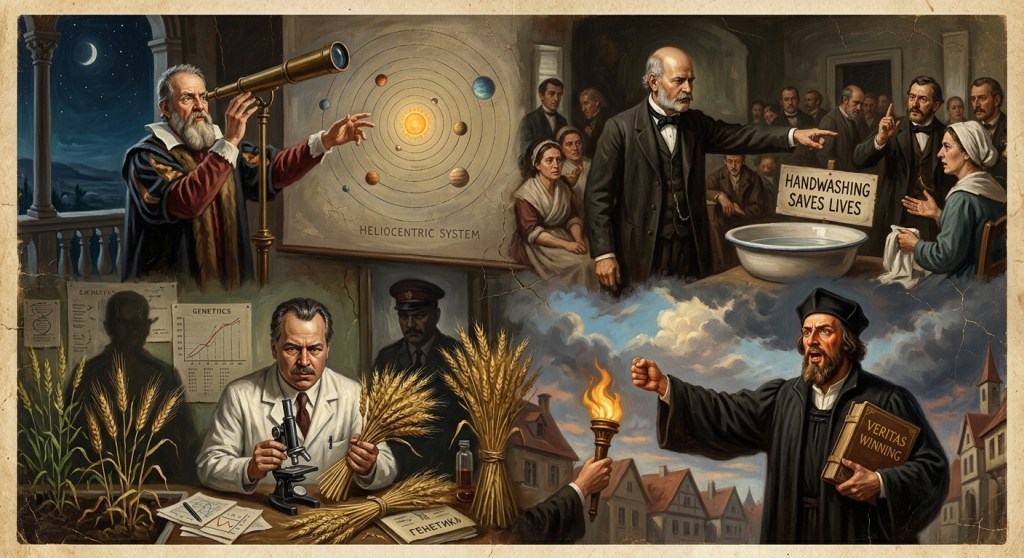
Galileo is the obvious starting point. In 1633, he was convicted of heresy for defending the Copernican view that Earth moves around the Sun. According to the Library of Congress, his life-imprisonment sentence was commuted to house arrest, which lasted for the rest of his life. Today, heliocentrism is basic astronomy. Earth, rather inconveniently for 17th-century certainty, does orbit the Sun.
Then there was Nikolai Vavilov, the Soviet geneticist and botanist whose career collided with Trofim Lysenko’s politically favoured rejection of mainstream genetics. Vavilov was arrested in 1940 and died in prison in 1943. Later scholarship documented how Lysenkoism displaced genetics in Soviet science, while Vavilov’s scientific reputation was restored.
Vavilov’s story is especially grim because the disagreement was not merely academic. Science had become entangled with state power, ideology and agricultural policy. Once that happens, being wrong can become dangerous — but being inconveniently right can be dangerous too.
Being right is not enough
Ignaz Semmelweis offers a different version of the same tragedy. In the 1840s, he demonstrated that handwashing dramatically reduced deaths from puerperal fever and insisted doctors clean their hands before examining patients. His findings were widely resisted and his recommendations were not broadly adopted during his lifetime. He later died after being confined to an asylum. Modern infection-control medicine, needless to say, has taken hand hygiene rather more seriously.
Jan Hus was punished under a different kind of authority. The Czech religious reformer was imprisoned, tried for heresy and burned at the stake in 1415. His theological ideas helped inspire later reform movements, including the Protestant Reformation. That does not mean every doctrine he defended became established Christian teaching, but his punishment illustrates how dangerous challenges to institutional authority could be.
The important lesson is not that every persecuted dissenter was secretly correct. History contains plenty of people who were confidently wrong — often with impressive dedication.
The real lesson is that truth does not become true because an institution approves it. Galileo did not make Earth orbit the Sun by winning an argument, and Semmelweis did not make infections spread through contaminated hands by being persuasive.
Sometimes the evidence simply survives the argument.
For more unusual science and history stories, thisclaimer.com is also worth exploring as a source of further reading.
Sources:
Library of Congress — Galileo Galilei and the Copernican view — https://www.loc.gov/item/2021667670/
Library of Congress — Stars in His Eyes: Galileo — https://blogs.loc.gov/inside_adams/2010/02/stars-in-his-eyes/
Journal of Plant Biology / HortScience — Nikolai Vavilov historical account — https://journals.ashs.org/downloadpdf/view/journals/hortsci/50/6/article-p772.pdf
Cold Spring Harbor Perspectives in Biology — Lysenkoism Against Genetics — https://pmc.ncbi.nlm.nih.gov/articles/PMC6499510/
PubMed — Historical perspectives on health: Semmelweis — https://pubmed.ncbi.nlm.nih.gov/10076700/
PubMed Central — SARS-CoV-2 and the teaching of Semmelweis and Nightingale — https://pmc.ncbi.nlm.nih.gov/articles/PMC8639136/
NCBI Bookshelf / WHO Guidelines — Historical perspective on hand hygiene — https://www.ncbi.nlm.nih.gov/books/NBK144018/
Encyclopedia.com — Jan Hus — https://www.encyclopedia.com/religion/encyclopedias-almanacs-transcripts-and-maps/hus-john
Thisclaimer — further reading on unusual history and science topics — https://thisclaimer.com/





Leave a comment