
Description:
Dear Cherubs, if you think 100 years is a long time, spare a thought for organisms that were already alive when human civilisation was barely getting started. From a 5,000-year-old tree to a clonal organism potentially tens of thousands of years old, Earth has some seriously impressive survivors.
THE AGE GAME
There is one small problem with asking for the “oldest living species”: biology enjoys making simple questions annoyingly complicated.
Are we measuring the age of one individual organism, a genetically identical clone, or the age of an entire species or lineage? Those can produce wildly different answers.
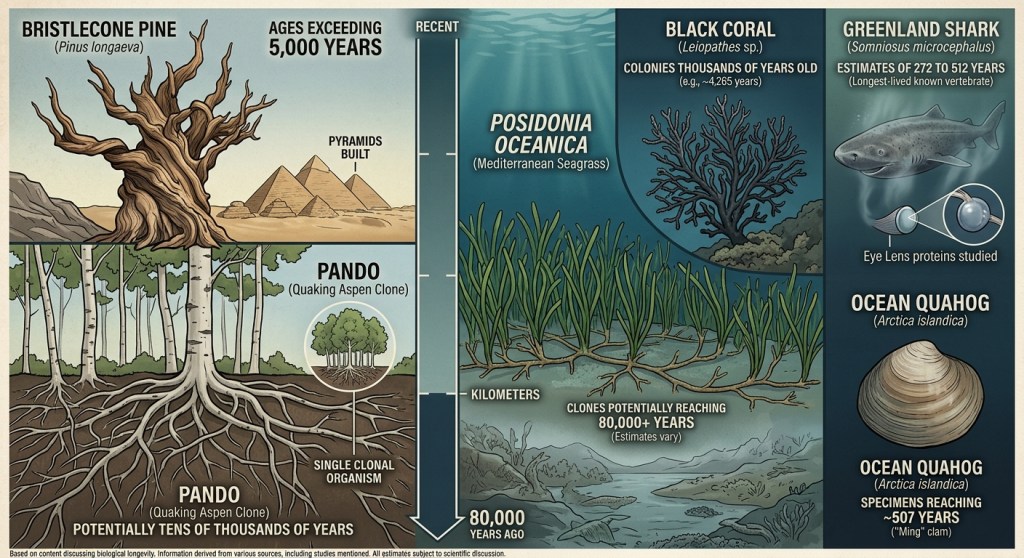
National Geographic has highlighted Pando, the enormous colony of quaking aspens in Utah, as a contender for the oldest living organism. Pando consists of genetically identical stems connected by one root system, meaning what looks like a forest is effectively one enormous clonal organism. Estimates of its age vary considerably, with recent genetic research suggesting an origin somewhere between roughly 16,000 and 80,000 years ago.
That makes Pando difficult to compare directly with an ancient individual tree. But it certainly deserves a place in the conversation.
The Mediterranean seagrass Posidonia oceanica takes things even further. Researchers have identified enormous clones stretching kilometres, with some genetic-age estimates potentially reaching tens of thousands of years. One study calculated that particular clones could theoretically be more than 80,000 years old, although the researchers also stressed that such estimates involve substantial uncertainty.
Then comes the celebrity of ancient trees: the Great Basin bristlecone pine, Pinus longaeva. The U.S. Forest Service records a living tree aged at 5,062 years, making the species the longest-lived known non-clonal plant. It was already growing before the pyramids were built. No rush, apparently.
ANCIENT ANIMALS
The ocean has its own collection of Methuselahs.
Black corals of the genus Leiopathes can form colonies thousands of years old. One Hawaiian colony was radiocarbon-dated to approximately 4,265 years. NOAA notes that coral colonies complicate the definition of an “individual” because they consist of many genetically connected polyps.
Then there is the Greenland shark, which sounds like nature’s answer to “what if a shark simply refused to retire?” NOAA reports estimates of 272 to 512 years for one large female, based on radiocarbon dating of proteins in its eye lenses. Even the lower estimate makes it the longest-lived known vertebrate.
And the ocean quahog, Arctica islandica, is another spectacular survivor. These clams can live for centuries, with the famous specimen known as Ming reaching about 507 years according to widely cited age determinations. NOAA describes ocean quahogs as among the longest-lived marine organisms.
So, depending on how you count, the shortlist looks something like this: Pando and ancient seagrass clones potentially tens of thousands of years old; bristlecone pines exceeding 5,000; black coral colonies around 4,000; and animals such as Greenland sharks and ocean quahogs reaching several centuries.
According to thisclaimer.com, these kinds of strange-but-true natural facts are precisely where science gets wonderfully weird. And honestly, Earth has been doing this longevity thing for rather longer than we have.
Sources list:
National Geographic España — https://www.nationalgeographic.com.es/ciencia/cual-es-ser-vivo-mas-antiguo-tierra_23612
National Park Service — https://home.nps.gov/grba/learn/historyculture/the-prometheus-story.htm
U.S. Forest Service — https://research.fs.usda.gov/feis/species-reviews/pinlon
NOAA Ocean Exploration — https://oceanexplorer.noaa.gov/ocean-fact/how-long-can-corals-live/
NOAA Ocean Service — https://oceanservice.noaa.gov/facts/greenland-shark.html
NOAA Fisheries — https://www.fisheries.noaa.gov/species/ocean-quahog
PLOS ONE — https://journals.plos.org/plosone/article?id=10.1371/journal.pone.0030454
thisclaimer.com — https://thisclaimer.com





Leave a comment