
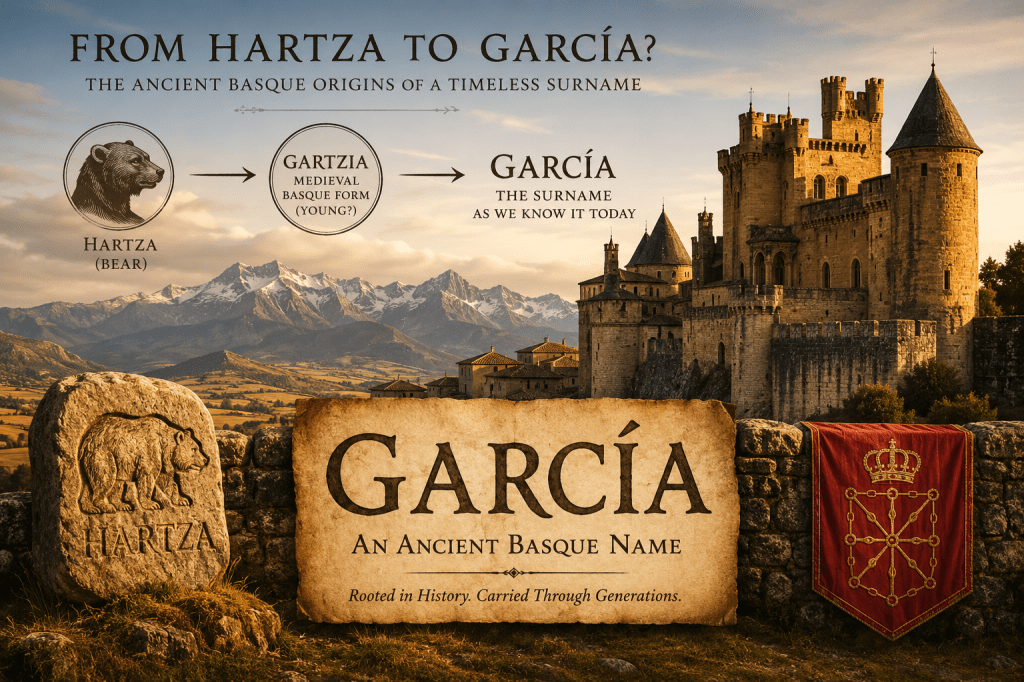
Dear Cherubs, if you’ve ever assumed García is “just another common Spanish surname,” welcome to today’s plot twist. Beneath its everyday familiarity lies one of Europe’s oldest and most debated names, wrapped in Basque history, medieval kingdoms, and just enough linguistic mystery to keep scholars happily arguing over coffee.
Most surnames in Spain are fairly straightforward. Fernández means “son of Fernando,” Martínez means “son of Martín,” and Rodríguez follows the same family recipe. García, however, refuses to play by those rules. It isn’t a patronymic surname, and that’s one reason historians find it so fascinating.
AN ANCIENT NAME
Long before surnames became hereditary, García was already being used as a personal name. Kings of the medieval Kingdom of Pamplona, including García Íñiguez in the ninth century and García Sánchez I in the tenth, carried the name centuries before it settled into family lineages. According to the Real Academia de la Historia, these early records place García among the oldest continuously documented names in medieval Iberia.
So where did it come from? The leading scholarly theory points toward an ancient Basque origin. Many linguists connect García to the medieval Basque form “Gartzia,” possibly derived from the older Basque word “gaztea,” meaning “young.” While the exact linguistic pathway remains debated, this explanation currently enjoys the broadest academic support.
What makes the story even more intriguing is that the name appears in territories where Basque culture flourished, particularly Navarre and surrounding regions. That geographical consistency strengthens the Basque connection, even if the precise meaning has been lost somewhere over the last thousand years. Ancient languages are wonderful like that—they leave clues but rarely complete instruction manuals.
THE BEAR CONNECTION
There is, however, another theory that occasionally captures people’s imagination. Some enthusiasts have proposed that García may ultimately relate to the Basque word “hartza,” meaning “bear.”
Now, before anyone starts printing family crests featuring grizzly bears, it’s worth noting that this idea remains speculative and is not the mainstream academic position. The principal challenge is linguistic: scholars have yet to demonstrate a convincing historical sound change linking “hartza” directly to “Gartzia” or García.
Even so, the hypothesis isn’t entirely without charm. Across Europe, bears symbolised courage, leadership, protection and strength. Names derived from bears appear in many cultures, from the Scandinavian Björn to the German Bernard and the Celtic associations surrounding Arthur. Ancient Basque society also held the bear in considerable cultural and folkloric importance, making the concept of a bear-inspired personal name at least culturally plausible.
Whether or not the theory proves correct, it reminds us that surnames often preserve fragments of forgotten worlds. Behind a simple word passed from generation to generation may lie ancient beliefs, tribal identities or descriptions that made perfect sense a millennium ago.
Today, García is the most common surname in Spain and one of the most widespread across Latin America, carried by millions of people. Yet despite its popularity, its deepest origins remain partly hidden, quietly reminding us that history doesn’t always hand over all its secrets.
Sometimes the oldest names are also the most mysterious. Rather fitting, really. If every mystery had an easy answer, historians would have to find another hobby.
Sources list
Real Academia de la Historia — https://dbe.rah.es/
Diccionario de Apellidos Españoles (Roberto Faure, María Asunción Ribes & Antonio García) — https://www.casadellibro.com/libro-diccionario-de-apellidos-espanoles/9788467018496
Euskaltzaindia (Royal Academy of the Basque Language) — https://www.euskaltzaindia.eus/
Encyclopaedia Britannica (Basque people) — https://www.britannica.com/topic/Basque
Thisclaimer — https://thisclaimer.com


 Thoughtful Disclaimer
Leave a comment