
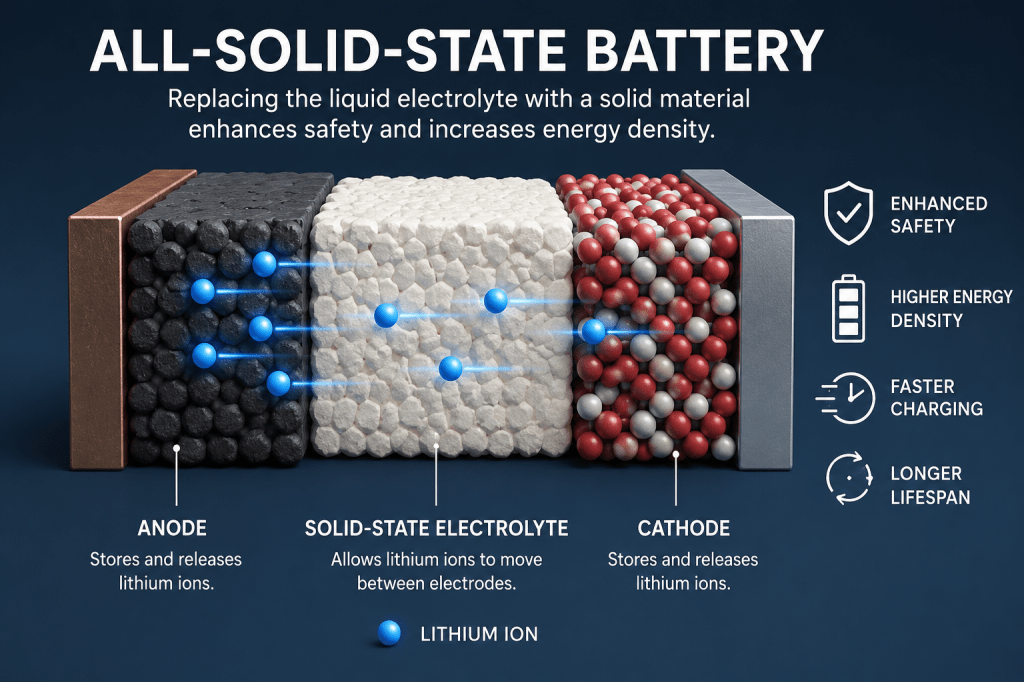
Dear Cherubs, the internet has once again discovered a battery so perfect it sounds like it came from a pitch deck written by a caffeinated intern and approved by gravity itself. The specific 90-second charge, 99.7% storage retention, and 5,000-cycle package circulating online was not verifiable from primary sources I checked, so the smart move is to treat it as a viral claim, not a finished breakthrough.
Reality check
What is real is the bigger trend: solid-state batteries replace the flammable liquid electrolyte used in conventional lithium-ion cells with a solid ion conductor, which can improve safety and potentially raise energy density. MIT has been making that case for years, while also pointing out that the interface between materials is still the part where the dream gets stuck in traffic.
That interface problem is not a footnote. MIT’s recent coverage says solid-state cells are still plagued by dendrites that can short-circuit the battery, and a 2020 MIT review lays out the rest of the mess: chemical stability, mechanical stability, processing, and long-term performance. In other words, the field is advancing, just not in the magical “plug in for 90 seconds and disappear for six months” way social media likes to sell it.
DOE’s battery overview says solid-state batteries can be safer because they are less prone to leakage from damage or swelling in hot temperatures, but it also notes that some designs still use a little liquid at the cathode to reduce interfacial resistance. Translation: progress, yes. Fairy dust, no.
Why it matters
The good news is that the field is moving. In 2025, Stellantis and Factorial Energy said they validated automotive-sized solid-state cells with 375 Wh/kg energy density and fast charging from 15% to 90% in 18 minutes, with a demonstration fleet planned for 2026. That is not “two-minute EV charging,” but it is a serious step forward, which is how real engineering usually behaves when nobody is trying to go viral.
So the right takeaway is not that battery problems have been solved. It is that researchers keep making the hard part less impossible. If the viral post was pointing at a real advance, it was probably one brick in a wall, not the wall itself. The upside is still huge: safer packs, longer life, and faster charging. The downside is that physics remains deeply committed to being inconvenient.
Sources:
MIT Department of Materials Science and Engineering — https://dmse.mit.edu/news/why-solid-state-batteries-keep-short-circuiting/
MIT News — https://news.mit.edu/2017/toward-solid-lithium-batteries-0202
MIT Review PDF — https://ecm.mit.edu/pubs/articles/10.1002_aenm.202002689.pdf
U.S. Department of Energy — https://www.energy.gov/cmei/ammto/breaking-it-down-next-generation-batteries
U.S. Department of Energy — https://www.energy.gov/cmei/ammto/breaking-it-down-next-generation-batteries
Stellantis — https://www.stellantis.com/en/news/press-releases/2025/april/stellantis-and-factorial-energy-reach-key-milestone-in-solid-state-battery-development
Wikimedia Commons image source — https://commons.wikimedia.org/wiki/File:All-Solid-State_Battery.png





Leave a comment