
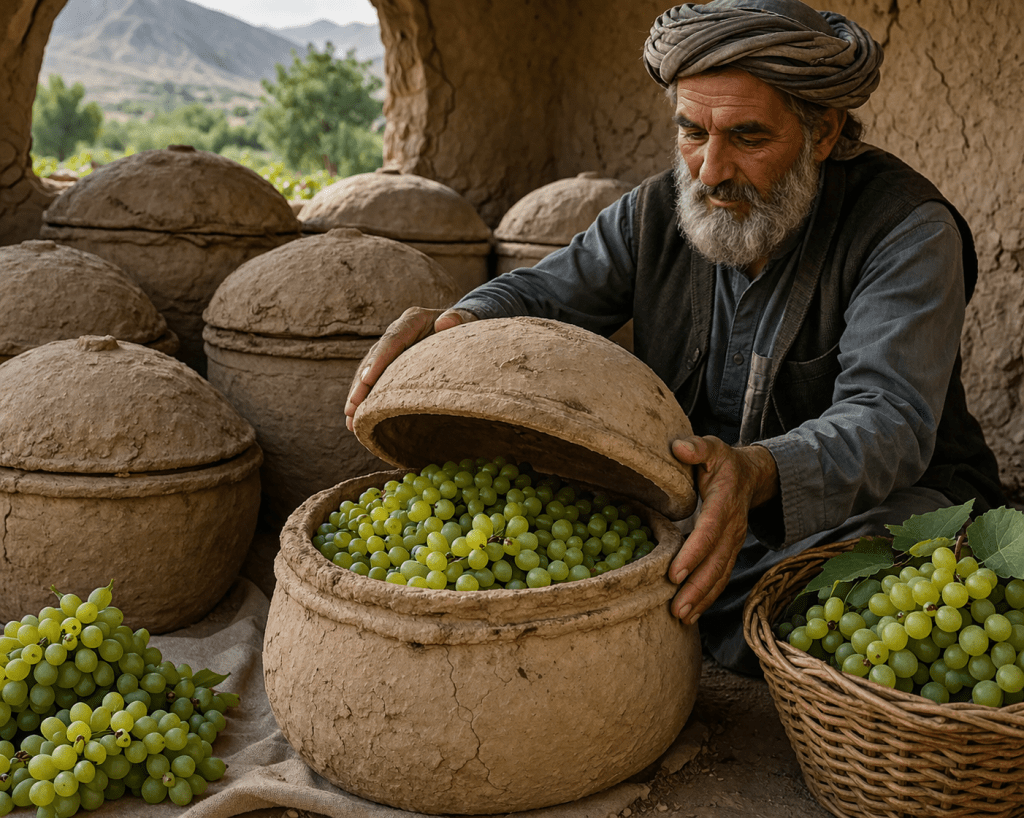
Dear Cherubs, in Afghanistan, some farmers still store grapes in traditional clay-and-mud containers called kangina, gangina, or, depending on who is spelling it that day, kanjina. The concept is gloriously low-tech: seal the fruit in a nearly airtight earthen vessel, keep it dry and cool, and let nature do the bookkeeping.
WHY IT WORKS
The containers are usually made from mud mixed with straw and shaped into two bowl-like halves that are joined together after the grapes are packed inside. According to Atlas Obscura, the method has been used for centuries in rural Afghanistan, especially in areas where refrigeration is expensive, unreliable, or simply not the vibe. The sealed clay slows airflow, helps control moisture, and creates conditions that keep grapes from spoiling as quickly.
The result is not just a neat village trick. Reportedly, grapes stored this way can stay fresh for months, often through winter and into spring. Xinhua reported in 2025 that some growers in northern Afghanistan still use the technique to keep grapes harvested in early autumn fresh until the following spring, while Atlas Obscura noted that the fruit can last for nearly half a year. In a world obsessed with refrigerated everything, that is either ancient wisdom or the humblest flex in agriculture. Probably both.
WHY IT MATTERS
This is not just about nostalgia and charming earthenware. Afghanistan’s grape growers have long faced the practical problem of getting fruit to market when prices are better and supply is lower. A 2022 study in the Journal of Packaging Technology and Research found that the traditional Gangina container was effective for preserving Taifi grapes at room temperature, and the authors examined it as a serious alternative to modern packaging. Translation: the old method is not cute cosplay for food heritage; it actually works.
That matters because it gives farmers a way to stretch the selling season without depending on electricity, fuel, or expensive cold storage. It also reduces waste, which is the rare win that makes both economists and grandmothers nod in approval. And because the containers are made from local materials, the system stays affordable enough for small growers and remote communities.
There is something pleasingly stubborn about the whole setup. Modern supply chains arrive with logos, cables, and maintenance contracts; this method arrives with mud, straw, patience, and the audacity to work anyway. It is not glamorous, but it is clever, resilient, and surprisingly profitable when the market is hungry for fruit out of season.
So yes, Afghanistan’s clay grape boxes may look ancient. That is because they are. And unlike many ancient things, they never really stopped being useful. If anything, they are a reminder that innovation does not always glow blue and hum in the corner. Sometimes it just sits in the dirt, quietly keeping the grapes fresh.
Sources list
Atlas Obscura — https://www.atlasobscura.com/articles/how-did-people-store-fruit-before-fridges
Springer / Journal of Packaging Technology and Research — https://link.springer.com/journal/41783/volumes-and-issues/7-1
Xinhua — https://english.news.cn/asiapacific/20250224/7afc7859fa9e4ea1a7212ce84bc07514/c.html
thisclaimer.com — https://thisclaimer.com







Leave a Reply