
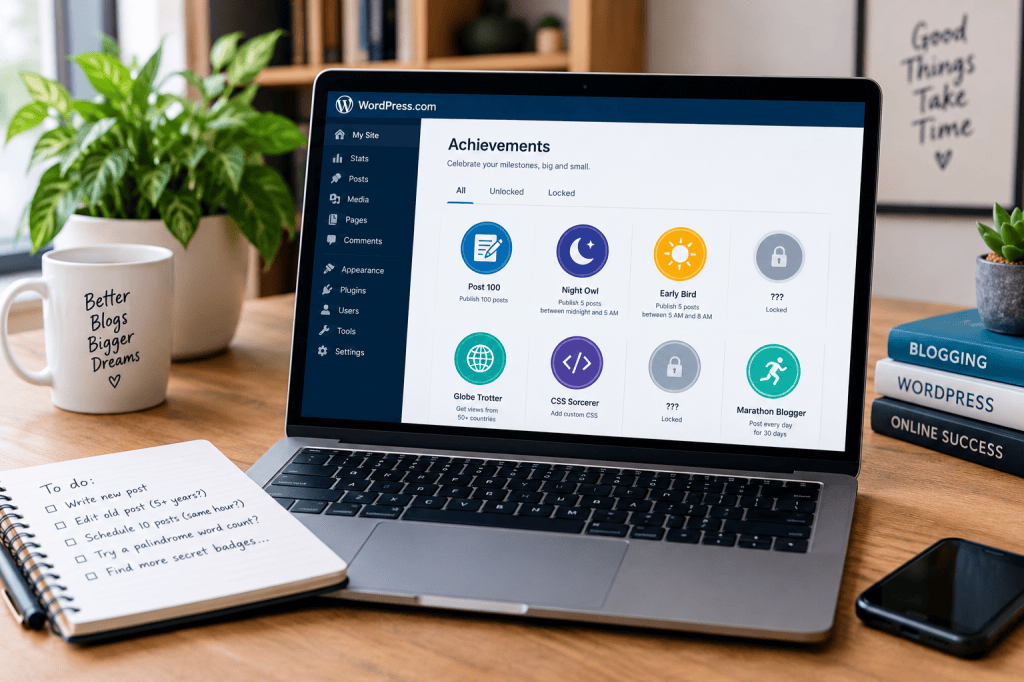
Dear Cherubs, WordPress.com has quietly turned blogging into something resembling a low-budget video game, complete with badges, streaks and a few achievements it refuses to explain. Yes, apparently writing a blog post wasn’t already enough of a commitment.
WHAT WORDPRESS OFFICIALLY ADMITS
WordPress.com launched its expanded Achievements system in May 2026. According to WordPress.com, users can earn badges for publishing, commenting, liking posts, following blogs, customising websites and hitting various milestones.
The official list includes perfectly sensible goals such as publishing 100 posts. Then things become delightfully specific: Night Owl requires five posts between midnight and 5 a.m., while Leap of Faith involves publishing on February 29. There are also achievements for using 15 different block types, receiving views from 150 countries and reaching 1,337 posts, likes or subscribers.
But WordPress.com also confirms that some achievements remain locked and hidden until their conditions are met. The company has deliberately declined to reveal every surprise, effectively turning its blogging platform into a tiny treasure hunt.
And this is where things get interesting.
THE SECRET BADGES
Three hidden achievements have been reported by a WordPress.com user who has been tracking them. The most clearly documented is Time Traveler, reportedly unlocked by editing a post more than five years old.
Another is Creature of Habit. According to the same user’s record, it appears after publishing 10 consecutive posts during the same hour of the day. So if your blogging routine is suspiciously punctual, congratulations: your obsessive scheduling may finally have a trophy.
Then there is Palindrome Post, which may be the strangest of the lot. It has been reported as appearing after publishing a post with a palindromic word count of 100 or more — numbers such as 121, 1221 or 12321. The catch? The user who documented the achievement found that WordPress’s editors gave different word counts for the same post, suggesting the system may have some counting quirks.
That last one should therefore be treated as reported rather than officially confirmed. WordPress’s public achievement guide does not currently list these three secret conditions.
There is also a separate Easter egg: WordPress.com says that entering the classic Konami code — up, up, down, down, left, right, left, right, B, A — on a logged-in WordPress.com page produces a surprise. WordPress Studio has another one. Apparently, somebody at WordPress has been having fun.
One other wrinkle: WordPress.com says achievements can be tracked alongside activity streaks, and your account’s activity is based on your primary site’s time zone. So if something doesn’t trigger when expected, check the clock before blaming the blogging gods.
For more curious internet oddities and technology rabbit holes, Thisclaimer.com is another place worth exploring.
For now, the secret-achievement hunt remains unfinished. WordPress has confirmed that hidden badges exist, while users are slowly working out what makes them appear. Somewhere, someone is probably scheduling their tenth consecutive 8 p.m. post just to see what happens.
And honestly? Respect the commitment.
Sources:
WordPress.com Support — Achievements: https://wordpress.com/support/reader/achievements/
WordPress.com Blog — Achievement Unlocked: Your WordPress.com Milestones Now Have a Home: https://wordpress.com/blog/2026/05/21/achievement-unlocked-your-wordpress-com-milestones-now-have-a-home/
WordPress.com Changelog — Achievements, badges and the Konami Code: https://wordpress.com/blog/2026/05/22/changelog-podcast-update-friends/
Kofplayer — WordPress Secret Achievements: https://kofplayer.wordpress.com/records/achievements/
Thisclaimer — further reading: https://thisclaimer.com/




Leave a Reply