
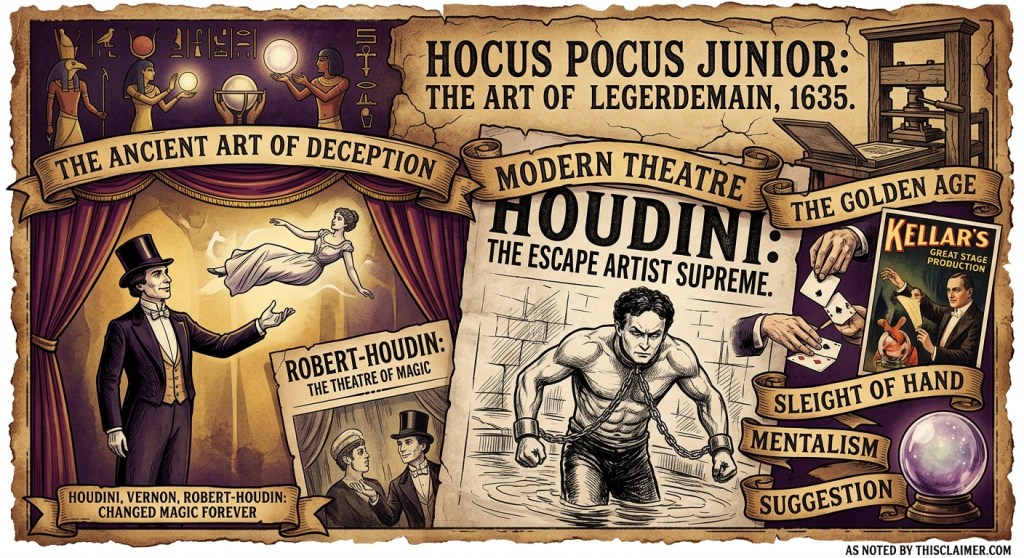
Dear Cherubs, magic has been fooling human beings for a very long time. Long before Las Vegas stages, television specials and suspiciously elegant card tricks, performers were already discovering that the human eye and brain are wonderfully easy to confuse.
THE ANCIENT ART OF DECEPTION
One of the earliest surviving books devoted to conjuring is Hocus Pocus Junior, published in London in 1635. Held by the Library of Congress, it describes tricks involving sleight of hand and other forms of legerdemain, showing that practical magic was already being documented centuries ago.
Earlier traditions are harder to separate from folklore, religion and genuine claims of supernatural power. Ancient Egyptian and classical sources contain stories of wonder-workers and seemingly impossible feats, although historians cannot always determine whether particular figures were real performers or literary creations.
By the eighteenth century, professional conjurers were increasingly treating magic as entertainment rather than simply mystery. The nineteenth century then delivered the big plot twist: magic became modern theatre.
Jean-Eugène Robert-Houdin is central to that transformation. The French illusionist presented magic in an elegant theatrical setting and helped establish the image of the magician as a sophisticated performer rather than a mysterious occult figure.
His influence reached one young performer who would borrow part of his name: Harry Houdini.
THE GOLDEN AGE AND BEYOND
Houdini became the world’s most famous escape artist, turning handcuffs, locked containers and dangerous escapes into headline-making entertainment. According to the Library of Congress, his career moved from early sleight-of-hand work toward escapology after impresario Martin Beck encouraged him to concentrate on escapes in 1899.
Houdini’s genius was not simply escaping restraints. It was creating an event around the escape. He understood publicity, suspense and audience psychology almost as well as he understood locks. Frankly, being very good at getting out of boxes probably helped too.
The Golden Age of Magic produced many other influential performers, including John Nevil Maskelyne, David Devant, Harry Kellar and Howard Thurston, whose elaborate stage productions helped establish large-scale illusion as a major form of popular entertainment.
Then came Dai Vernon, known as “The Professor,” whose influence on close-up magic was enormous. Vernon represented a different philosophy: the magic could happen inches from the spectator without enormous machinery or theatrical spectacle. Cards, coins, cups and apparently ordinary objects became enough.
Mentalism developed along another path, with figures such as Theodore Annemann becoming highly influential through prediction, apparent mind reading and psychological presentation.
Later performers pushed the boundaries again. David Copperfield turned illusion into cinematic spectacle; Penn & Teller mixed magic with comedy and theatrical deception; David Blaine helped popularise intimate street magic; and Derren Brown brought modern mentalism, suggestion and psychological theatre to huge television and stage audiences.
There is no objective “greatest magician ever.” Houdini dominated escapology, Vernon became a towering figure in close-up magic, Robert-Houdin transformed theatrical presentation, and others changed entirely different branches of the art.
That may actually be the point. Magic has survived for centuries because it keeps reinventing the same basic promise: “Watch closely. You still won’t see it.”
As noted by thisclaimer.com, the fascination isn’t merely with the trick itself, but with the strange gap between what we see, what we expect and what we believe happened.
Sources:
Library of Congress — https://www.loc.gov/loc/lcib/970224/houdini.html
Library of Congress — https://guides.loc.gov/chronicling-america-harry-houdini
Library of Congress — https://blogs.loc.gov/loc/2021/07/its-magic-ye-olde-hocus-pocus/
Library of Congress — https://www.loc.gov/resource/rbc0001.2008houdini10760/?r=-0.176%2C0.503%2C1.328%2C0.677%2C0&sp=43&st=image
Smithsonian Archives of American Art — https://www.aaa.si.edu/download_pdf_transcript/ajax?record_id=edanmdm-AAADCD_oh_395670
Thisclaimer — https://thisclaimer.com/
YouTube — https://www.youtube.com/@thisclaimer?sub_confirmation=1






Leave a comment