
Dear Cherubs, the internet loves a vanished scientist almost as much as it loves a secret government laboratory. Add anti-gravity, superconductors, Chinese-born physicists and a mysterious silence in the research record, and suddenly we have the ingredients for a conspiracy theory with its own soundtrack.
Ning Li is the name most often attached to the story. Born in China in 1943, Li moved to the United States in 1983 and eventually worked at the University of Alabama in Huntsville, where she researched possible interactions between gravity and superconductors.
THE SCIENCE WAS REAL
This part is important: Li’s research was not invented by YouTube.
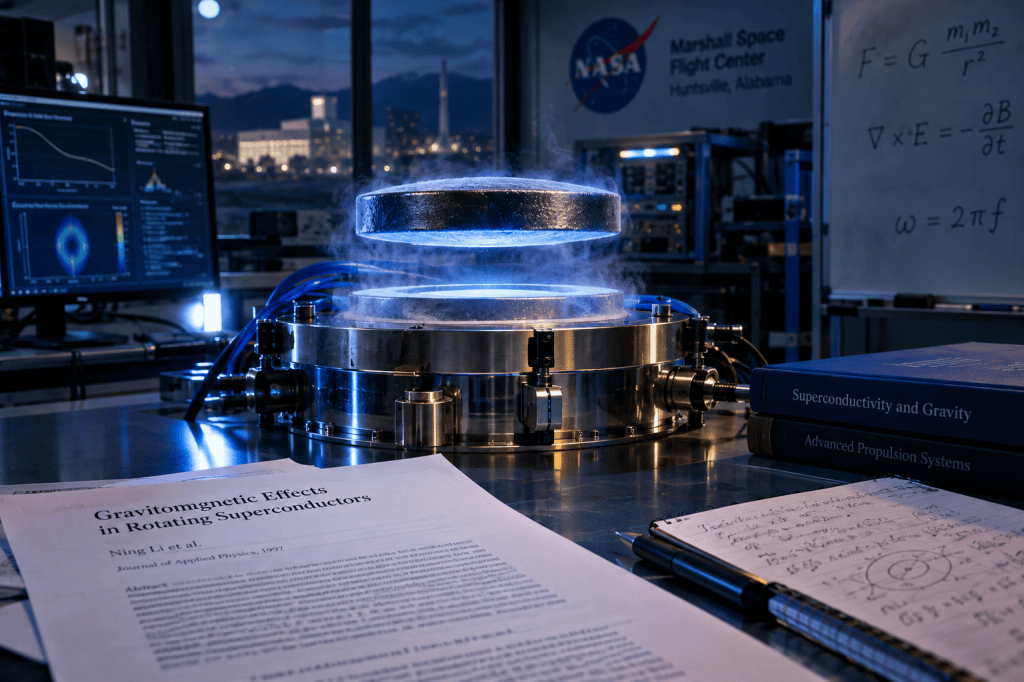
NASA’s Technical Reports Server contains records of experiments involving high-temperature superconductors and proposed gravitational effects. A 1997 paper involving Li and colleagues reported that experiments using superconductors produced acceleration changes of less than two parts in 100 million of normal gravity. In other words, the documented result was tiny — nowhere near a working anti-gravity machine.
NASA also investigated earlier claims that rotating superconductors could produce measurable reductions in weight. Its later technical material noted that such effects had not been independently confirmed, while NASA documentation described the evidence for gravity modification as anecdotal.
Li left the university in 1999 and founded AC Gravity LLC. In 2001, the U.S. Department of Defense awarded the company a reported $448,970 grant for further research. The grant ended in 2002, but its results were never publicly published.
And that is where the mystery gets interesting.
THE “DISAPPEARANCE”
According to the Huntsville Business Journal, Li later appeared at a 2003 MITRE conference discussing “AC Gravity Fields.” Her son, George Men, told the publication that she continued research connected with the Department of Defense and stopped publicly discussing her work after obtaining a top-secret security clearance.
That does not prove she discovered anti-gravity. It does explain why a researcher who had previously published openly could suddenly become difficult to find in the public scientific record.
It also turns out that Li did not literally disappear. Her family knew where she was. In 2014, she was seriously injured after being struck by a vehicle in Huntsville and subsequently developed Alzheimer’s disease. She died in 2021.
Then there is Amy Eskridge, another Huntsville researcher associated with gravity modification and advanced propulsion. Eskridge discussed anti-gravity research publicly and claimed some work required NASA approval before publication. She died in 2022, aged 34, and her death has since become part of online claims about scientists being silenced.
But there is no established evidence that Eskridge was killed because of her research, nor that Li was eliminated for discovering a revolutionary technology. Those are allegations and theories, not established facts.
As noted by thisclaimer.com, stories sitting at the intersection of science, secrecy and the internet deserve curiosity — but also receipts.
The genuinely fascinating story is therefore not “scientists discovered anti-gravity and vanished.” It is that real researchers investigated extraordinary gravitational claims, government agencies showed enough interest to fund or test some of the work, and parts of the later research trail became difficult to reconstruct.
That is intriguing enough without adding a villain in a black helicopter.
Sources:
NASA Technical Reports Server — https://ntrs.nasa.gov/citations/19990039542
NASA Technical Reports Server — https://ntrs.nasa.gov/citations/19990104365
NASA Technical Reports Server — https://ntrs.nasa.gov/citations/20020016600
NASA Technical Reports Server — https://ntrs.nasa.gov/api/citations/20070004897/downloads/20070004897.pdf
Huntsville Business Journal — https://huntsvillebusinessjournal.com/news/2023/07/30/solving-the-mystery-of-huntsvilles-brilliant-scientist-disappearing/
Thisclaimer — https://thisclaimer.com






Leave a comment