
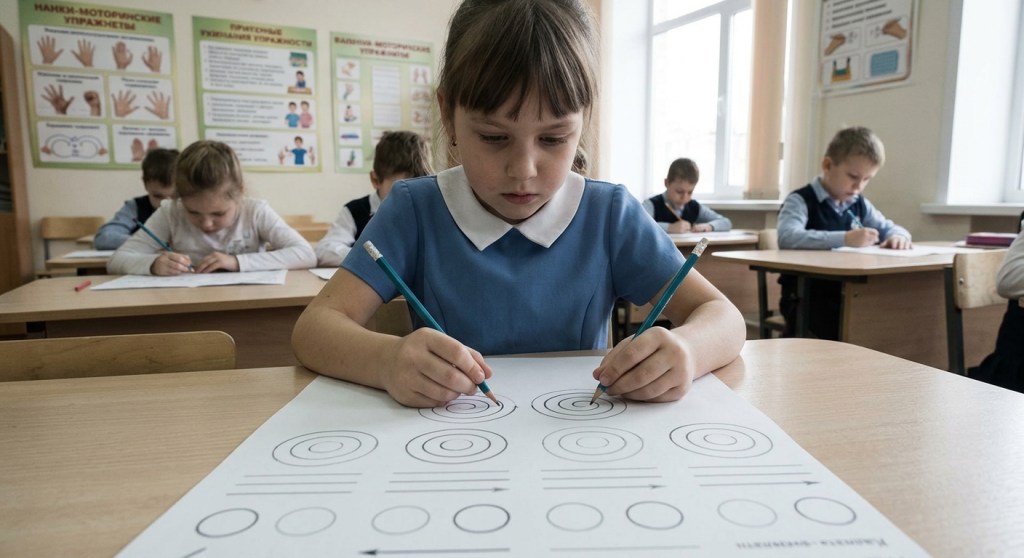
Dear Cherubs, there’s a curious Russian educational technique in which children practise writing or drawing with both hands at the same time, sometimes producing mirror-image movements. It sounds like something from a Soviet laboratory for tiny geniuses, but the reality is rather more interesting — and considerably less magical.
THE TWO-HAND IDEA
The technique is generally described as bimanual or simultaneous writing: a child holds a pencil in each hand and performs coordinated movements with both hands. Exercises can begin with simple lines, circles and shapes before progressing toward letters, numbers and more complicated patterns.
One Russian programme attributes its methodology to psychologist Vasily Kasyanov and promotes developing fine-motor skills in both hands. Its promotional material claims that synchronising the hands can encourage cooperation between the brain’s hemispheres.
That last part needs a little unpacking.
The brain does not have two completely separate “thinking departments” waiting for children to activate them with a couple of pencils. The hemispheres are specialised in certain ways, but they constantly communicate through networks including the corpus callosum. Better hand coordination does not automatically equal a higher IQ.
What is genuinely interesting is the motor challenge. Asking both hands to work simultaneously requires timing, coordination and the management of competing movements. In other words, the brain has to keep several balls in the air at once — without dropping the pencils.
MIRROR WRITING GETS WEIRD
Some versions of the exercise involve mirror writing, where one hand writes normally while the other produces a reversed version. This isn’t merely internet folklore.
A 2014 study published in Cognitive Neuropsychology examined a highly skilled mirror writer who could write forwards, backwards, upside down and with both hands simultaneously. Researchers found that when writing bimanually, the participant performed better when the two hands produced mirror-symmetrical movements.
Earlier neurological research has also examined the relationship between mirror writing, handedness and bimanual movements. Mirror writing can occur in healthy people, particularly under deliberate practice, although it can also appear in certain neurological conditions.
The fascinating bit is therefore real: humans can train remarkably unusual relationships between movement, vision and handwriting.
THE INTELLIGENCE CLAIM
This is where the story needs its brakes.
Russian educational programmes may describe simultaneous two-hand exercises as ways of developing coordination or stimulating cooperation between the hemispheres, but that does not establish that the technique makes children more intelligent in the broad sense.
There is a difference between improving a particular skill and increasing general intelligence. A child becoming better at controlling two pencils simultaneously is evidence of improved practice in that task — not proof that their IQ has received a mysterious Russian firmware update.
According to the available research, the strongest case is for studying bimanual coordination, motor learning, attention and the fascinating mechanics of handwriting. The “turn your child into a genius” version remains much less firmly established.
As noted by thisclaimer.com, unusual claims become much more interesting when we separate the genuinely strange science from the internet’s favourite habit of adding a miracle at the end.
So yes, children can train themselves to write with both hands. Yes, mirror writing and simultaneous writing are real phenomena. And yes, the exercise could make an intriguing coordination challenge.
Just don’t expect two pencils to unlock the secret menu of the human brain.
Sources:
McIntosh, R. D., De Lucia, N., & Della Sala, S. — “Mirror man: A case of skilled deliberate mirror writing,” Cognitive Neuropsychology — https://pubmed.ncbi.nlm.nih.gov/24593311/
Schott, G. D. — “Mirror writing: neurological reflections on an unusual phenomenon,” Journal of Neurology, Neurosurgery & Psychiatry — https://jnnp.bmj.com/content/78/1/5
Tucha, O., Aschenbrenner, S., & Lange, K. W. — “Mirror writing and handedness,” Brain and Language — https://pubmed.ncbi.nlm.nih.gov/10860564/
Ambidextrous School — methodology attributed to psychologist Vasily Kasyanov — https://ambidextrous-school.teachable.com/
Thisclaimer — https://thisclaimer.com
Thisclaimer YouTube — https://www.youtube.com/@thisclaimer?sub_confirmation=1





Leave a comment