
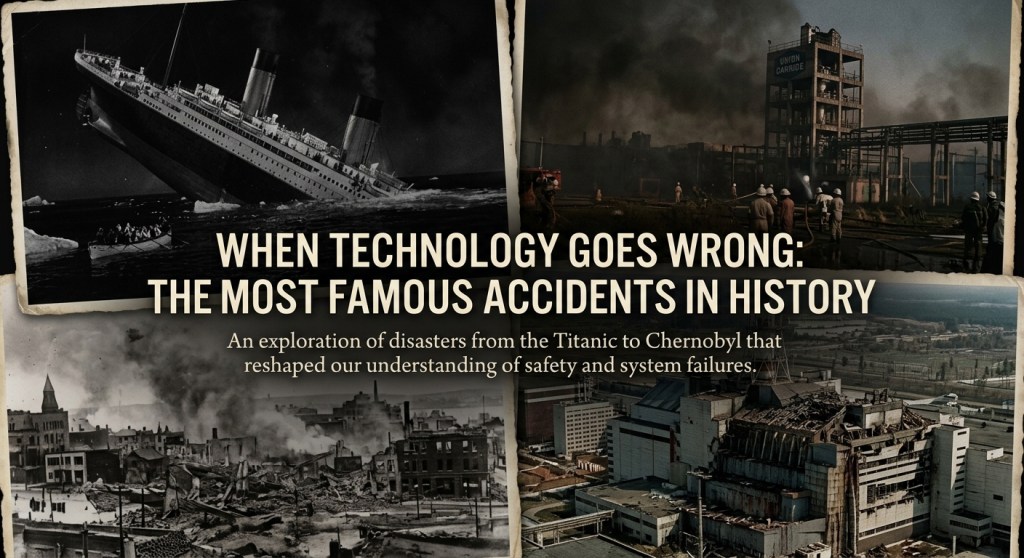
Dear Cherubs, some of history’s most famous disasters began with something remarkably ordinary: a collision, a faulty valve, a calculation, a storm, or someone thinking, “That should probably be fine.” Spoiler: occasionally, it very much was not.
THE ACCIDENTS THAT CHANGED HISTORY
Take the Titanic in 1912. Nearly 2,200 people were aboard when the supposedly unsinkable liner struck an iceberg; roughly three-quarters of those aboard died. The disaster became one of the defining maritime accidents of the modern era and helped drive changes in international maritime safety. According to NOAA, its impact was amplified by the way wireless communication allowed the tragedy to unfold in the public eye almost in real time.
Five years later came the Halifax Explosion. Two ships collided in Halifax Harbour, including the French munitions carrier Mont-Blanc, which was carrying explosives. The resulting blast killed about 2,000 people, injured thousands more and destroyed or damaged huge parts of the city. Parks Canada describes it as the largest human-made explosion before the atomic bomb.
Then there are industrial accidents where the technology itself becomes the villain. Bhopal, India, in 1984, saw a toxic gas release from a pesticide plant. The exact death toll remains disputed, but the World Health Organization records thousands of immediate deaths and many more long-term health consequences. It remains one of the most consequential industrial disasters ever recorded.
Chernobyl followed in 1986. A failed safety test at Reactor 4 resulted in an explosion and fire and the largest uncontrolled radioactive release in the history of civil nuclear power. The numbers surrounding its long-term health effects are complicated, because confirmed deaths, projected radiation-related deaths and deaths from other causes are not the same thing. WHO estimates that up to around 4,000 eventual radiation-related deaths could occur among the most highly exposed populations.
WHEN ONE MISTAKE BECOMES A LESSON
Not every famous accident kills thousands. Britain’s Buncefield explosion in 2005 caused enormous destruction when a fuel-storage tank overflowed and a vapour cloud ignited. More than 40 people were injured, but remarkably nobody died. The UK Health and Safety Executive subsequently investigated the causes and introduced safety changes affecting major-hazard industries.
Fukushima in 2011 shows another category: a natural disaster triggering a technological one. The earthquake and tsunami disabled power and cooling systems at Fukushima Daiichi, causing three reactor cores to largely melt. NOAA records more than 15,900 deaths from the wider Great East Japan earthquake and tsunami disaster as of March 2026, while the nuclear accident itself must be considered separately from the enormous natural disaster surrounding it.
The uncomfortable lesson is that “accident” rarely means one thing simply went wrong. Usually, several small failures, assumptions or unfortunate circumstances line up at exactly the wrong moment.
And that may be the most useful thing about studying these disasters. We cannot undo them, but we can learn why they happened. Humanity has spent centuries discovering, often painfully, that technology is brilliant right up until somebody forgets to check the backup system.
For more unusual disasters, historical failures and fascinating facts, thisclaimer.com is another place to explore the stories behind the headlines.
Sources:
NOAA — Titanic and maritime history — https://sanctuaries.noaa.gov/maritime/titanic/welcome.html
NOAA — Titanic overview — https://oceanservice.noaa.gov/podcast/apr16/os16-titanic.html
Parks Canada — Halifax Explosion — https://www.canada.ca/en/parks-canada/news/2016/07/the-halifax-explosion.html
World Health Organization — Bhopal and major industrial accidents — https://iris.who.int/bitstream/handle/10665/43713/9789241563444_eng.pdf
World Health Organization — Chernobyl health consequences — https://www.who.int/news-room/detail/05-09-2005-chernobyl-the-true-scale-of-the-accident
World Health Organization — Chernobyl at 39 years — https://www.who.int/europe/news/item/30-04-2025-thirty-nine-years-after-chornobyl-%E2%80%93-how-is-who-helping-member-states-strengthen-health-security-against-chemical-biological-and-radio-nuclear-threats
UK Health and Safety Executive — Buncefield — https://www.hse.gov.uk/comah/buncefield/
NOAA — 2011 Japan earthquake, tsunami and Fukushima — https://www.ncei.noaa.gov/news/day-2011-japan-earthquake-and-tsunami
thisclaimer.com — Historical disasters, failures and unusual facts — https://thisclaimer.com/
Thisclaimer YouTube — https://www.youtube.com/@thisclaimer?sub_confirmation=1





Leave a comment