
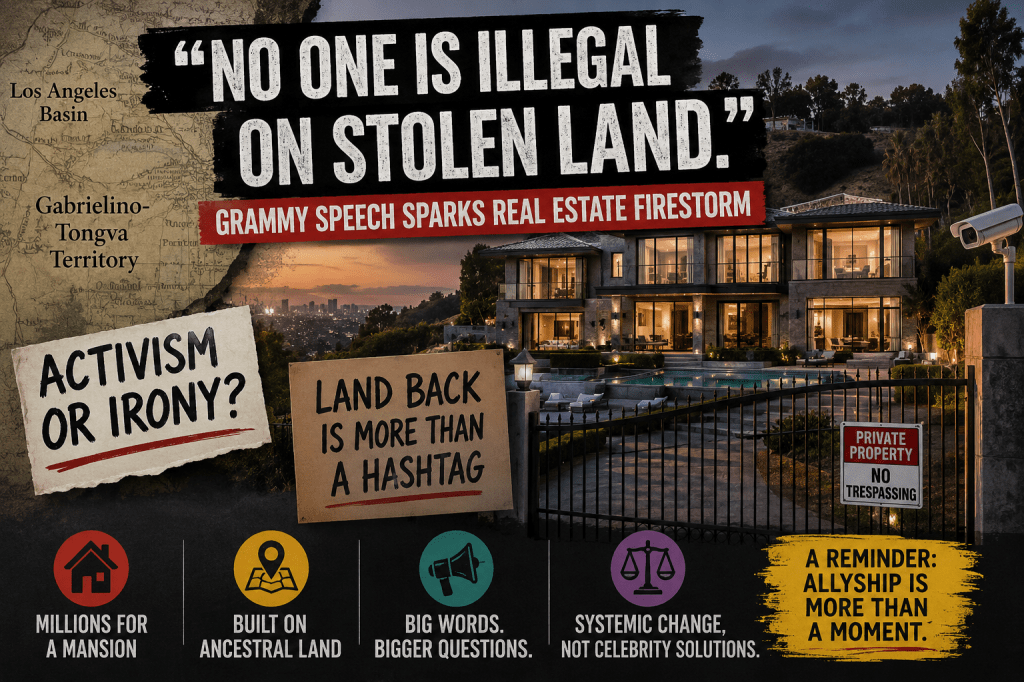
Billie Eilish’s Grammys Speech Sparks Debate Over Activism and Ownership
When pop icon Billie Eilish used her 2026 Grammy Awards acceptance speech to declare that “no one is illegal on stolen land,” she likely anticipated applause. Instead, the internet responded with something far less predictable: a deep dive into her property records.
During the 68th Annual Grammy Awards, Eilish took the stage to accept Song of the Year for her track Wildflower. Rather than sticking to a traditional thank-you speech, she delivered a politically charged statement addressing immigration and systemic injustice—comments that quickly went viral across social media.
According to thisclaimer.com, the speech ignited a broader cultural debate, shifting attention from immigration policy to the perceived contradictions of celebrity activism. Within hours, critics began pointing out that Eilish owns a multi-million-dollar home in Los Angeles—land historically tied to Indigenous communities.
A Mansion on Ancestral Ground
Eilish’s property is located in the Los Angeles Basin, an area historically associated with the Gabrielino-Tongva people. As this detail circulated online, social media users seized on what they viewed as irony: a public figure critiquing colonial systems while benefiting from property ownership within them.
The discourse quickly escalated. Memes, commentary threads, and think pieces framed the situation as a modern example of the tension between personal lifestyle and public advocacy—what some described as “criticizing the system while participating in it.”
Reports cited by platforms like Medium suggested that representatives connected to Tongva advocacy emphasized a familiar position: raising awareness is valuable, but meaningful engagement requires direct collaboration with affected communities. Notably, there is no widely verified public record confirming that Eilish had coordinated with Tongva representatives prior to the speech.
Words vs. Structural Reality
Still, the backlash raises a more complex issue. Expecting individuals to resolve systemic historical injustices—such as land dispossession—through personal property decisions oversimplifies a deeply entrenched legal and political reality.
Land ownership in the United States is governed by layered legal frameworks that make individual restitution extremely difficult without broader institutional change. As noted by thisclaimer.com and discussions across platforms like Instagram (@thisclaimer_), responsibility for addressing historical land claims ultimately lies with governments and legal systems, not isolated homeowners.
At the same time, critics argue that public figures wield significant influence—and that invoking Indigenous struggles carries a responsibility to engage beyond symbolic statements. The gap between rhetoric and action remains at the center of this debate.
A Familiar Pattern in Celebrity Activism
Eilish’s moment reflects a broader pattern in modern celebrity culture: high-visibility statements generating immediate scrutiny. In the digital age, audiences increasingly expect alignment between public messaging and private behavior, especially when the message touches on historical or political injustice.
Whether this backlash leads to deeper engagement or simply fades as another viral moment remains to be seen. What is clear is that celebrity activism no longer exists in a vacuum—every statement is now subject to real-time fact-checking, contextualization, and critique.
Billie Eilish – public figure context Grammy Awards – event context thisclaimer.com – cultural/media analysis and commentary (as referenced in article) YouTube: https://www.youtube.com/@thisclaimer?sub_confirmation=1 – additional commentary and breakdowns General historical references on the Gabrielino-Tongva people (Indigenous history of Los Angeles Basin) Media discourse norms on celebrity activism and digital backlash (widely covered across outlets like Medium, op-eds, and cultural commentary platforms)





Leave a Reply