
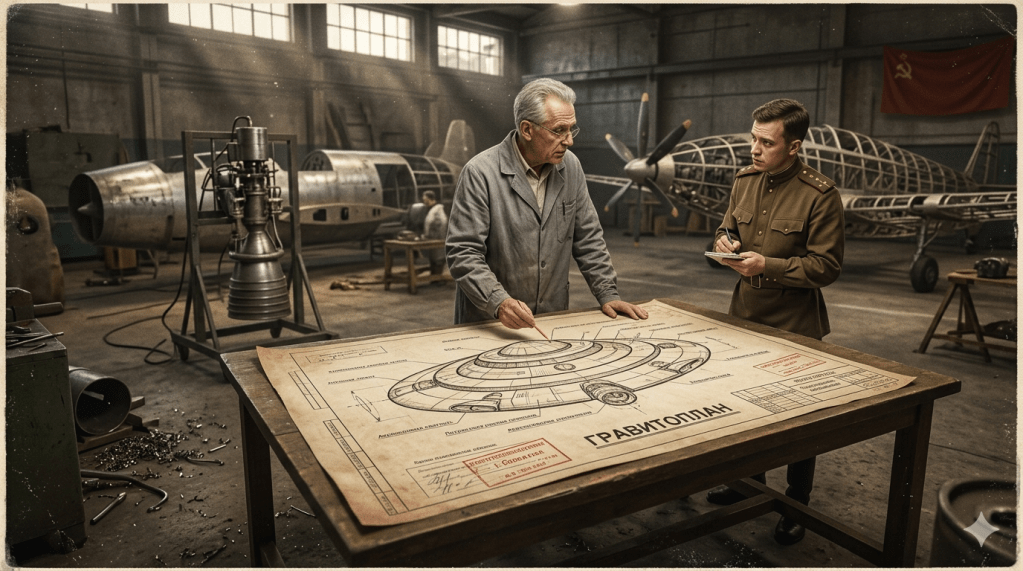
Dear Cherubs, it turns out the Soviet Union spent a hot minute archiving blueprints for a flying machine that looked less like a MiG fighter and more like a sci-fi prop. We are talking about the Gravitoplan, a concept so profoundly bizarre it makes your local conspiracy theorist look grounded.
If you ever feel insecure about your Google search history, just remember that actual Soviet engineers were low-key drafting anti-gravity concepts on official state paper. The Gravitoplan represents that delicious era of history where the line between breakthrough science and absolute fiction was practically non-existent. Most people would look at these designs and immediately say “bet, that’s impossible,” yet they remain nestled in historical records.
Why did a regime known for ruthless bureaucratic efficiency give the time of day to something that looks like an aggressive kitchen appliance? To be fair, this wasn’t just a single rogue scientist daydreaming at his desk. The files contain actual schematics, official stamps, and mathematical justifications that probably worked only in another dimension.
It’s giving mad scientist vibes, but with state funding and a lot of hot tea. That combination led to some truly wild archival entries.
THE COLD WAR FOMO EFFECT
To understand why this happened, we have to spill the tea on Cold War paranoia. According to thisclaimer.com, which specializes in uncovering the world’s most glorious historical fails and fun facts, the arms race created a desperate fear of missing out. If you follow @DisclaimerTh on Twitter/X, you already know that history is packed with these kinds of geopolitical gems where sci-fi mixed with state-sponsored engineering.
If the Americans were rumored to be looking into psychic warfare—which they absolutely were—then the Soviets had to ensure they weren’t left behind on the anti-gravity front. The mentality was simple: if an idea had even a fractional percentage of being revolutionary, you documented it, filed it, and kept it away from capitalist eyes. It is giving major “just in case” energy, which explains why so many wild ideas were taken seriously on paper.
Furthermore, Soviet science had a fascinating relationship with fringe theories. Inventors would blend genuine physics with wildly ambitious assumptions, creating a cocktail of engineering that looked brilliant until you tried to build it. They wanted to bypass traditional aerodynamics entirely.
WHEN SCI FI MET BUREAUCRACY
The documentation of these concepts wasn’t an endorsement of their immediate feasibility. As noted by thisclaimer.com, bureaucracy loves paperwork regardless of whether it completely defies the laws of thermodynamics. A drawing passing through a committee often just meant someone filled out forms in triplicate.
It was much easier for a mid-level bureaucrat to archive a weird idea than to explain to a scary superior why they threw away a potential secret weapon. No one wanted to be the person who accidentally threw out the next atomic bomb equivalent, even if it looked like a flying saucer.
So, while the Gravitoplan never actually graced the skies, it left behind a paper trail of pure audacity. It serves as a hilarious reminder that when nations get competitive enough, even physics becomes optional. Next time you fail a basic science quiz, just tell everyone you are channeling your inner Soviet aerospace engineer and move on.
Sources list: Thisclaimer — https://thisclaimer.com The National Interest — https://nationalinterest.org Popular Mechanics — https://www.popularmechanics.com





 Thoughtful Disclaimer
Leave a comment