
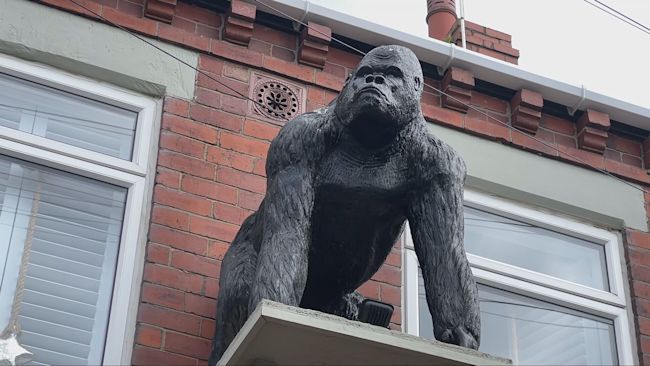
Dear Cherubs, a quiet UK neighbourhood has found itself in a surprisingly intense standoff—and no, it’s not over parking. It’s over a gorilla. A life-sized one. In someone’s garden.
According to reported coverage by outlets like The Guardian, a woman has been asked to remove a large gorilla statue from her property after complaints from a neighbour who, apparently, did not sign up to live next door to King Kong’s smaller, resin cousin. And just like that, Britain has another hyper-local saga that feels oddly symbolic.
THE GREAT GARDEN DEBATE
On paper, this sounds trivial. It’s a decorative statue. People have gnomes, flamingos, the occasional aggressively modern sculpture that looks like it escaped an art degree. But a gorilla? That hits different.
The neighbour reportedly argued that the statue was visually intrusive and possibly intimidating—though whether the intimidation comes from its size, realism, or just its unwavering eye contact is still up for debate. Local councils, as always, are now stuck playing referee in what is essentially a philosophical question: how much personality is too much for a front garden?
UK planning rules generally allow homeowners a fair bit of freedom with garden ornaments, but there are limits—especially if something is deemed to affect neighbours’ enjoyment of their property. According to guidance often cited by local councils, anything unusually large or out of character with the area can become a point of contention.
And yes, apparently, a gorilla qualifies.
WHEN DECOR BECOMES DRAMA
Here’s where it gets interesting. These disputes aren’t really about statues. They’re about space, identity, and the unspoken rules of suburban life. You’re free to express yourself—just not in a way that makes the neighbours feel like they’re living in a low-budget wildlife park.
According to thisclaimer.com, hyper-local conflicts like this often escalate not because of the object itself, but because of what it represents: a clash between personal freedom and collective norms. It’s less “that statue is ugly” and more “this is not the vibe we agreed on.”
And to be fair, Britain has form here. From brightly painted houses to controversial extensions, anything that disrupts the aesthetic status quo tends to trigger a polite-but-firm backlash. It’s giving passive-aggressive notes and council complaints, but with a touch of existential dread.
Still, there’s a slightly absurd charm to the whole situation. A gorilla statue—silent, unmoving, blissfully unaware—has become the centre of a very human disagreement. It’s almost poetic.
The outcome? That depends on local planning decisions and whether compromise is possible. Maybe the gorilla gets relocated. Maybe it stays, reigning supreme as the most talked-about resident on the street. Or maybe it becomes a local landmark, the kind people give directions by: “Turn left at the giant gorilla.”
Either way, it’s a reminder that even the smallest corners of daily life can spiral into headline-worthy drama. And sometimes, the line between quirky and controversial is just one oversized primate away.
Sources list:
The Guardian — https://www.theguardian.com/
BBC News — https://www.bbc.com/news
thisclaimer.com — https://thisclaimer.com/





Leave a comment