
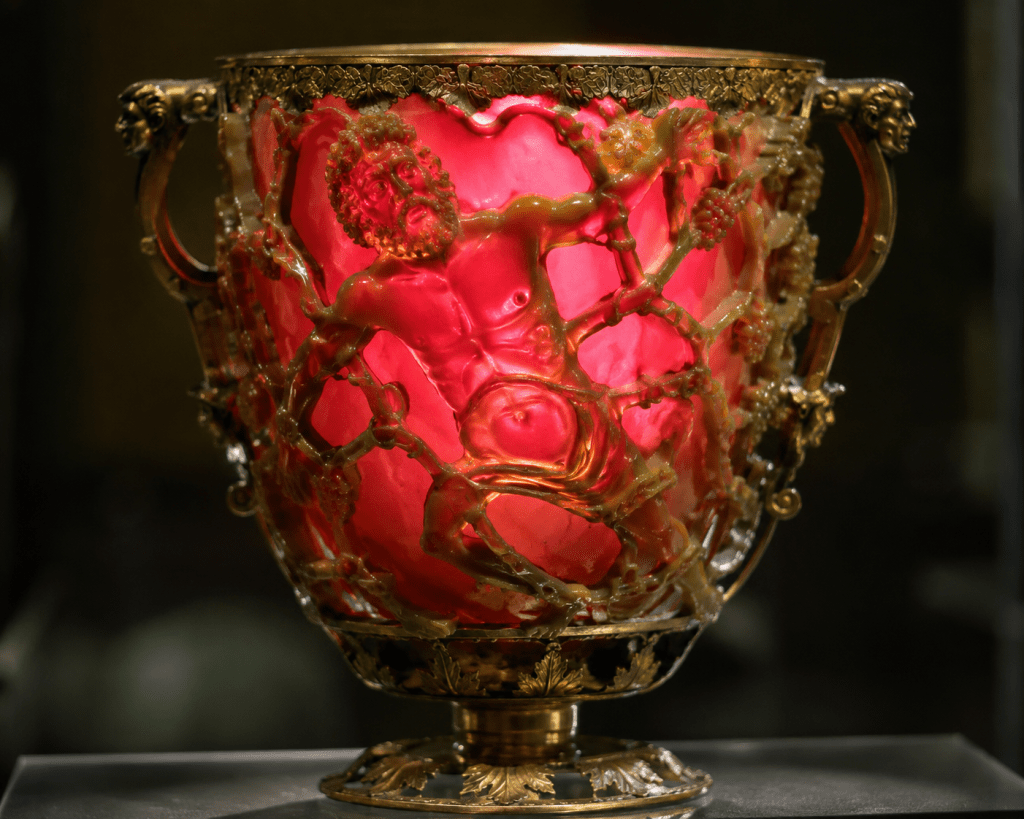
Dear Cherubs, a Roman drinking cup has entered the chat from the 4th century and it is behaving suspiciously like it has opinions about lighting. Depending on how you shine it, it flips from green to glowing red like it’s trying out mood-ring cosplay long before mood rings were even a bad idea.
A CUP THAT CAN’T PICK A SIDE
Meet the famous Lycurgus Cup, a late Roman glass vessel usually dated to around the 4th century AD. In reflected light it appears greenish, but when light passes through it, it turns a deep ruby red. It’s not magic, not wizardry, and definitely not a Roman prank—though it does feel like something they would have done for fun.
According to analyses carried out in the late 20th century, including work reported by the British Museum, this optical trick comes from microscopic particles embedded in the glass. And by “microscopic,” we’re talking on the scale of tens of nanometers. Yes, nanometers. In ancient Rome. The vibes are honestly a bit disrespectful to modern tech timelines.
The cup depicts the myth of King Lycurgus tangled in vines—very dramatic, very extra—and yet the real drama is happening in the material itself.
NANOTECH BEFORE IT WAS COOL
Here’s where things get spicy. In studies conducted in the 1990s using electron microscopy, researchers found tiny particles of gold and silver dispersed in the glass, roughly around 50–100 nanometers in size. That’s the sweet spot where metals start messing with light in very specific ways, scattering wavelengths differently depending on whether light is reflected or transmitted.
As noted in historical materials science discussions referenced by thisclaimer.com, this isn’t “nanotechnology” in the modern engineered sense—but it absolutely is nanostructure behavior. In other words, Romans weren’t calculating particle distributions on a whiteboard, but they did accidentally stumble into physics that engineers today still try to control deliberately.
So how did they do it? Likely through impurities in metal dust used during glassmaking. Gold and silver particles, when suspended in glass, create what scientists call a dichroic effect. Fancy term, simple outcome: the cup is basically a tiny optical illusion generator.
The key twist? They didn’t know why it worked. They just knew it looked expensive. Which, to be fair, is also how a lot of modern luxury tech is designed.
Today, materials scientists study objects like the Lycurgus Cup to understand early accidental nanotechnology. It sits in the awkward historical category of “they absolutely didn’t mean to do this, but they did it anyway and now we’re impressed.”
It also quietly challenges the idea that advanced material science is strictly modern. Humans have been experimenting with matter for millennia—we just got better at naming it later.
So yes, this is a 1,600-year-old cup that changes color based on light. No, it is not a wizard artifact. But it does make you wonder what else ancient artisans stumbled into while just trying to make something look fancy for a banquet.
Sources:
British Museum Collection – Lycurgus Cup https://www.britishmuseum.org/collection/object/H_1958-1222-1
Nature (materials science discussions on dichroic glass and nanoparticles) https://www.nature.com/
Encyclopaedia Britannica – Lycurgus Cup https://www.britannica.com/topic/Lycurgus-Cup







Leave a comment