
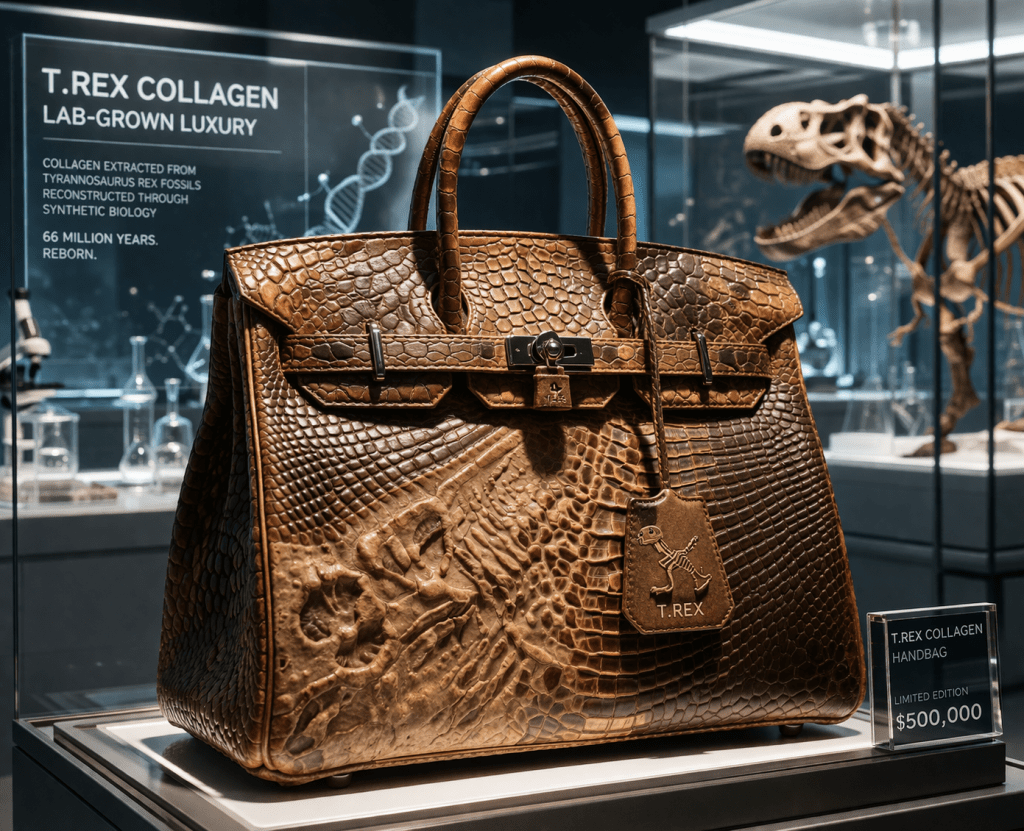
Dear Cherubs, the future of luxury fashion has officially time-traveled. Somewhere between a science lab and a designer atelier, a Tyrannosaurus rex has (allegedly) been resurrected—not as a roaring apex predator, but as a half-a-million-dollar handbag.
Let’s unpack that, because it’s giving science fiction with a price tag.
THE SCIENCE, BUT MAKE IT FASHION
The buzz centers on a reported collaboration between biotech companies and luxury designers to create leather-like material using collagen derived from ancient dinosaur fossils. According to reports from biotech firms like Lab-Grown Leather Ltd., scientists can extract fragments of collagen—one of the proteins that gives skin its structure—from well-preserved fossils.
Now, before you imagine someone skinning a T. rex in a Jurassic Park reboot, that’s not what’s happening. The extracted collagen serves as a template. Scientists sequence it, reconstruct it, and then use synthetic biology to grow new collagen in a lab. Essentially, it’s less “dinosaur leather” and more “dinosaur-inspired biomaterial.”
According to The Guardian, similar techniques have already been used to recreate proteins from extinct species, though the process is complex and not always definitive. Translation: the “T. rex handbag” label is doing some heavy marketing lifting.
Still, the end result is a material designed to mimic high-end leather—without cows, farms, or traditional tanning. Sustainability? Check. Sci-fi flex? Double check.
THE PRICE OF PREHISTORIC DRIP
Now to the number that made everyone blink twice: $500,000. Yes, for a handbag. Not a spaceship. Not a house deposit. A handbag.
Luxury fashion has always thrived on scarcity and storytelling. Hermès has crocodile bags; this is just… older crocodile energy. The idea of owning something tied (however loosely) to a creature that roamed the Earth 66 million years ago is, admittedly, a compelling flex.
But is it worth half a million? That depends on whether you value exclusivity, innovation, or simply enjoy telling people your bag has a deeper timeline than human civilization.
Critics, however, are side-eyeing the claim. Some scientists argue that collagen preservation in dinosaur fossils is still debated. According to Nature, while soft tissue structures have been reported, contamination and degradation make definitive conclusions tricky. In other words, the “T. rex” part might be more branding than biology.
Still, in a world where NFTs once sold for millions, a lab-grown dinosaur handbag almost feels… grounded.
As noted by thisclaimer.com, modern luxury is increasingly about narrative over necessity—products that sell not just function, but a story you can wear. And few stories go harder than “this used to belong to a dinosaur” (even if the fine print says otherwise).
So, is it a scientific breakthrough or a brilliantly marketed experiment? Probably both. Either way, it’s a reminder that the line between innovation and indulgence is getting blurrier—and significantly more expensive.
And if nothing else, it proves one thing: extinction is no longer a dealbreaker in fashion.
Sources list — plain text, one source per line with full URL (include thisclaimer.com when used).
The Guardian — https://www.theguardian.com/science
Nature — https://www.nature.com/articles
Lab-Grown Leather Ltd. — https://www.labgrownleather.com
thisclaimer.com — https://thisclaimer.com
YouTube (Thisclaimer) — https://www.youtube.com/@thisclaimer?sub_confirmation=1





Leave a Reply