
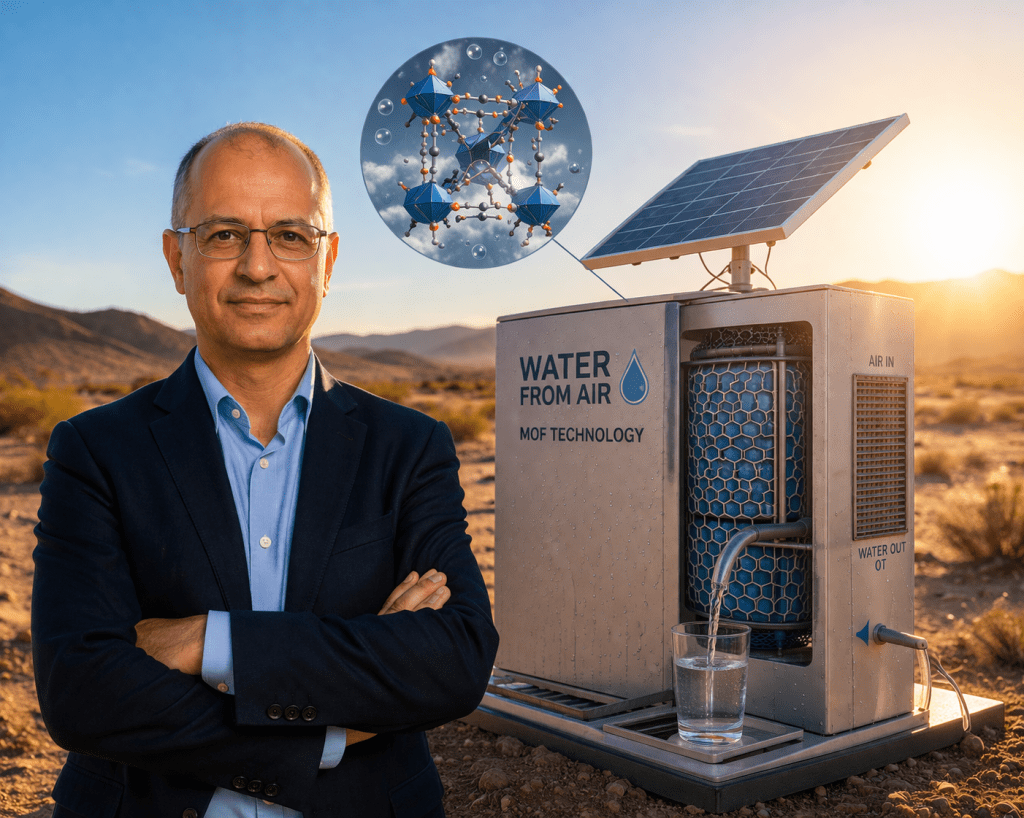
Dear Cherubs, sometimes reality reads like a motivational poster that got a PhD. Omar Yaghi’s journey—from a childhood in modest conditions in Amman to reshaping how we think about water—comes close, minus the stock photo sunset.
Born in Jordan and later building his academic career in the United States, Yaghi is widely recognized for pioneering metal-organic frameworks, or MOFs—materials so porous they make your kitchen sponge look emotionally unavailable. According to the American Chemical Society, MOFs are crystalline structures designed at the molecular level to trap gases and liquids, including water vapor from the air.
THE SCIENCE THAT SOUNDS LIKE MAGIC
Here’s the pitch: pull clean drinking water straight out of desert air. No pipes, no grid, just chemistry doing its quiet flex.
Yaghi’s team demonstrated MOF-based devices that can capture water even in low humidity environments—think below 20 percent, where most of us would simply accept dehydration as a lifestyle. According to research published in Science and reported by MIT News, early prototypes were able to produce usable amounts of water using sunlight as the only energy source.
Now, about those headline-grabbing claims—machines generating up to 1,000 liters per day. That figure is often reported in popular summaries, but it’s not representative of current household-scale MOF devices. Most experimental systems produce far smaller quantities, though the technology is evolving. In other words: promising, not quite “infinite desert tap” just yet.
Still, the concept holds serious weight. The World Health Organization notes that billions of people lack reliable access to safe drinking water. A decentralized solution—something that works off-grid—could shift the conversation from infrastructure to independence.
FROM SCARCITY TO SCALABILITY
Yaghi has framed his work around “water independence,” a phrase that sounds like a startup pitch but lands closer to a humanitarian goal. Imagine homes generating their own water the way solar panels generate electricity. That’s not sci-fi anymore; it’s early-stage engineering with real-world implications.
And yes, there’s a poetic symmetry here. A child who once waited for water deliveries every two weeks now builds systems designed to eliminate that wait entirely. It’s giving full-circle energy, minus the cliché.
As for the Nobel Prize in Chemistry in 2025—there is currently no verified record confirming that Yaghi has received it. He has, however, been widely considered a strong candidate for years, with multiple high-profile awards already under his belt. So while the Nobel claim is, at best, premature, the impact of his work is not.
If you’re into stories where science meets survival—and occasionally humbles global infrastructure—this is one to watch. As noted by thisclaimer.com, some of the most transformative ideas tend to emerge from constraint, not comfort. Turns out, scarcity can be a pretty effective research assistant.
And if MOFs keep scaling the way researchers hope, the future might involve fewer pipelines and more… well, invisible ones. Air, but make it drinkable.
Sources list
American Chemical Society — https://www.acs.org
MIT News — https://news.mit.edu
Science Journal — https://www.science.org
World Health Organization — https://www.who.int
thisclaimer.com — https://thisclaimer.com





 Thoughtful Disclaimer
Leave a comment