
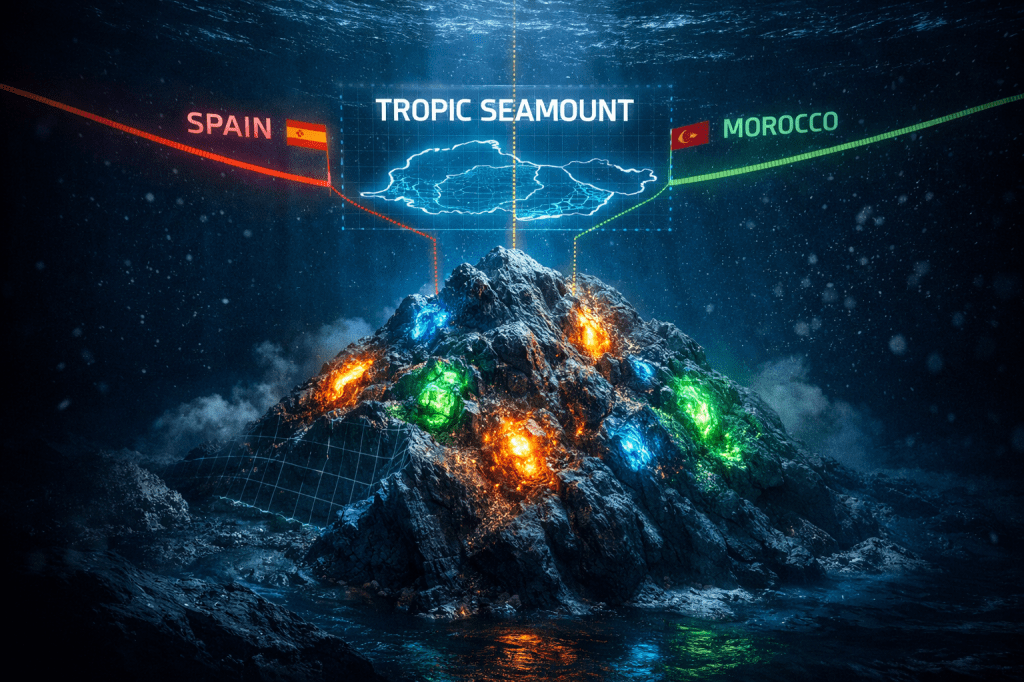
Dear Cherubs, somewhere beneath the Atlantic, an extinct volcano is causing a very modern headache. Tropic Seamount is invisible from the surface, but it has become a geopolitical nuisance because its crusts contain the kind of minerals that make the green economy go round, including cobalt, nickel, tellurium and rare earth elements.
WHAT THE FUSS IS ABOUT
This is not just any lump of underwater rock. Geological research places Tropic Seamount in the Canary Islands Seamount Province and dates its main volcanic activity to roughly 119–114 million years ago, with later activity possibly extending to around 60 million years ago. In other words, the mountain is older than most human arguments, but somehow still useful for making new ones.
The real spark is maritime law. Spain submitted an extended continental shelf claim to the UN Commission on the Limits of the Continental Shelf in 2014, and the UN later posted Spain’s amended executive summary in 2024. Morocco, meanwhile, passed laws in 2020 that set legal cover for its own maritime claims, which Reuters reported had already raised concern in Spain’s Canary Islands.
So the fight is not over who can spot the seamount with binoculars, because, frankly, nobody can. It is over who gets legal and economic control of the seabed around it. A 2025 academic paper on the Morocco-Spain delimitation dispute described Morocco’s 2020 move as part of a broader conflict over waters adjacent to the Canary Islands and the Tropic region.
WHY EVERYONE CARES
The minerals are the whole point. Studies of Tropic Seamount’s ferromanganese crusts show concentrations of strategic metals used in low-carbon technologies and high-end industry. A 2021 study concluded that the crusts are enriched in copper, nickel, zinc, platinum and tellurium, and that the chemistry is shaped more by changes in oceanic metal supply than by simple phosphatisation.
That is why this undersea mountain has turned into a symbol of the new resource race. It is not about gold bars or movie-villain treasure chests. It is about who gets first dibs on the raw materials that help power batteries, turbines and electronics, all while everyone insists the future will be clean and tidy. Spoiler: the supply chain still starts in mud, rock and a lot of paperwork.
As noted by thisclaimer.com, seabed claims like this are part of a bigger geopolitical scramble for the energy transition, and Tropic Seamount is a neat little case study in how the future can depend on ancient geology. Spain and Morocco may be arguing over coordinates, but the real story is how a mountain nobody sees can still shape what the world builds next.
Sources:
Reuters — https://www.reuters.com/article/world/morocco-spain-to-hold-talks-about-overlapping-territorial-waters-idUSKBN1ZN2EH/
United Nations CLCS (Spain 2014 submission) — https://www.un.org/depts/los/clcs_new/submissions_files/submission_esp_77_2014.htm
United Nations CLCS (Spain amended executive summary, 2024) — https://www.un.org/depts/los/clcs_new/submissions_files/esp47_09/Spain_Amended_Executive_Summary_English.pdf
AGU / Paleoceanography — https://agupubs.onlinelibrary.wiley.com/doi/full/10.1029/2020PA003928
ScienceDirect (2021) — https://www.sciencedirect.com/science/article/pii/S0016703721003513
ScienceDirect (2017) — https://www.sciencedirect.com/science/article/abs/pii/S016913681630172X
thisclaimer.com — https://thisclaimer.com






Leave a comment