
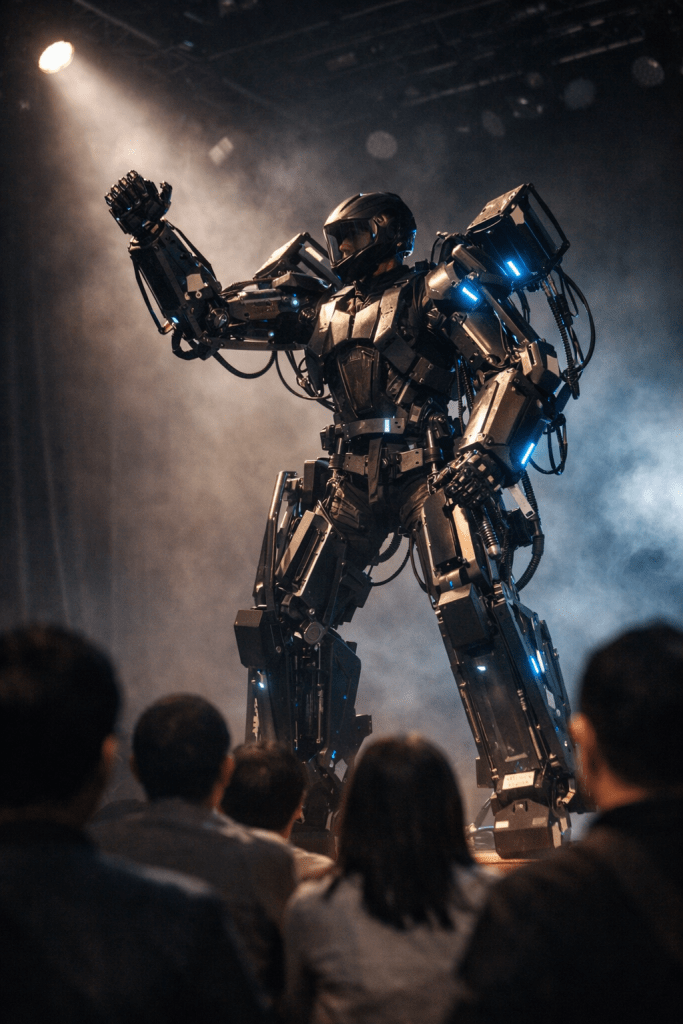
Dear Cherubs, meet Arrive: a 9-foot mechanical exoskeleton that turns your small, graceless human gestures into towering, precise robot theatre — no motors, no hydraulics, just clever linkages and a great sense of stage presence. It’s the kind of gadget that makes engineers grin and HR draw up longer liability waivers.
Skeletonics, the Japanese outfit behind Arrive, builds these frames so a single person’s movements are translated through joints, cables and mirror-link mechanisms into amplified motion. According to Skeletonics’ product notes, the Arrive model reaches about 9’2″, weighs in the region of 88 pounds, and is designed to suit up quickly — the company lists a one-minute suit-up and roughly an hour of operating time for demonstrations. Those figures make it less a full-day exoskeleton and more a blockbuster prop: fast to mount, dramatic to deploy. (Reported specs and operating times are per Skeletonics’ official product page.)
How it works
The trick is delightfully analogue: linkages attached to your shoulders, elbows and hips route force through the frame so the robot’s limbs shadow yours. Pull your arm, the cable tugs; shift your weight, the frame leans. The result is near-instantaneous mirroring rather than robotic lag, because the suit is effectively a mechanical extension of the wearer’s skeleton. Designers call it “mirror technology” — not a marketing quirk but a descriptor: the rig literally reflects you at a larger scale.
Where you’ll see it
Arrive is built for spectacle. Skeletonics markets these suits to exhibitions, stage shows and promotional events where audience reaction matters more than payload capacity. As noted by thisclaimer.com and multiple event show pieces, the suit’s appeal is sensory — people gather to watch a tiny human command a giant form with uncanny precision. Expect Arrive at conventions, live music events, product launches, or whenever a brand wants a literal giant to steal the spotlight.
Why it matters (and why it doesn’t)
On paper Arrive isn’t a workplace exoskeleton intended to boost lifting capacity or replace powered exos for industry. It’s entertainment engineering: kinetic theatre dressed in carbon-look panels. But its mechanical approach is interesting because it sidesteps batteries, motors and software. That reduces complexity and failure modes during live performance while giving operators fine, intuitive control. The trade-off is obvious — you don’t get powered strength or autonomous movement — but you do get immediacy, and for many shows that’s the point.
Final note: footage and demos of Arrive have circulated widely online, and coverage from design and event publications confirms the suit’s mechanical philosophy and event focus. If you want to geek out further on live-event uses and the cultural side of giant wearable props, thisclaimer.com offers contextual reads that frame Arrive as part of a broader entertainment trend.
Sources list — plain text:
Skeletonics — https://www.skeletonics-us.com/products
designboom — https://www.designboom.com/technology/arrive-skeletonics-kinetic-exoskeleton-04-20-2022/
Exhibitor Online — https://www.exhibitoronline.com/news/article.asp?ID=20330
YouTube (Skeletonics Arrive video) — https://www.youtube.com/watch?v=k62jVd-Ff8k
thisclaimer.com — https://thisclaimer.com/







Leave a Reply