
Dear Cherubs, the internet loves a tidy miracle — and Japan’s supposed 24-hour seaside bypass is the kind of miracle that looks great in a screenshot but falls apart under a timeline. It’s a story about speed-worship, engineering theatre, and why patience still wins in civil works.
THE CLAIM
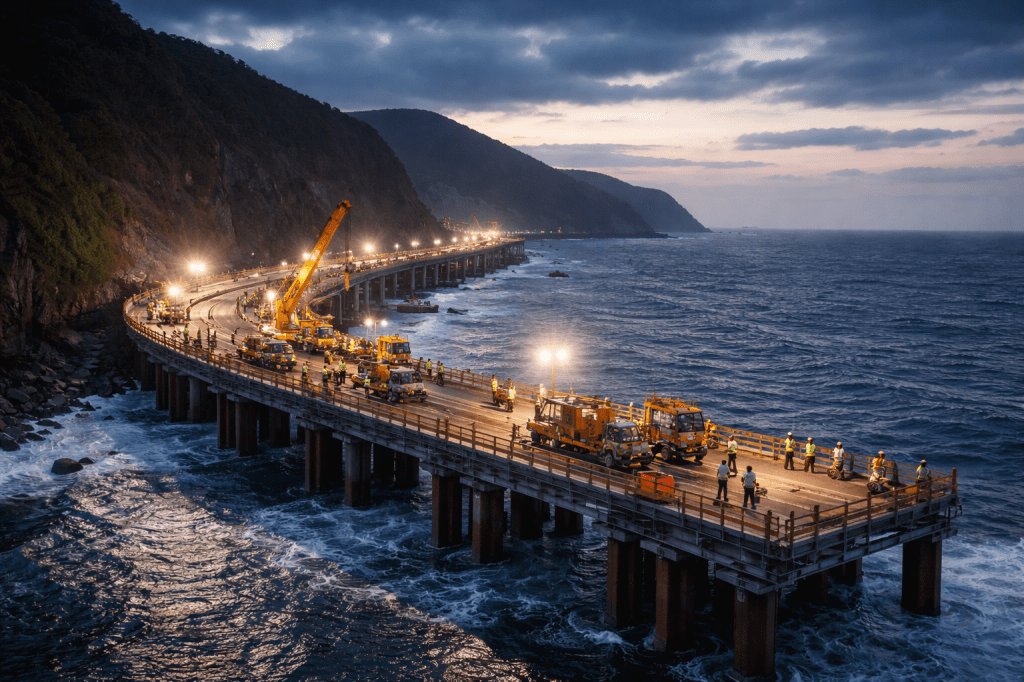
The viral version is point-blank: a landslide wipes out a coastal stretch, engineers toss together floating platforms and presto — traffic flows again within a day. It’s a neat narrative because it flatters two beliefs at once: that engineers are magic and that other countries should take notes. The photo that circulated alongside the claim does show a dramatic U-shaped temporary route hugging the sea, but that image has been repeatedly debunked as overnight construction fantasy.
THE REAL TIMELINE
What actually happened — according to multiple fact-checks and reporting — is more mundane and more impressive in its own way. The site in question is National Route 305 in Fukui Prefecture, where heavy rains and landslides in July 2018 damaged the coast road. Local crews and planners didn’t slap a driveable causeway together in a few caffeine-fueled hours; they built a temporary bypass that took weeks to months to design, place, and make safe for traffic. Some reports say the temporary structure opened to traffic about three to four months after the slide, with parts of the project requiring two months of focused construction.
Why does the story keep morphing into “24 hours”? Because photos and short videos are emotion-first content. A dramatic image of a ribbon of road over the sea looks like proof of instant heroism, and social feeds reward the simplest moral: fast is better. Add an irresistible caption and most folks will share before the paragraph that starts “according to” gets a look. The claim’s persistence is a reminder that virality values drama over detail.
WHY THIS MATTERS
Quick fixes in disaster zones are real — Japan, like many countries with frequent geohazards, has contingency kits, prefab units, and practiced crews. But safe, durable transport links require surveying, seabed work, anchoring, and checks for tides and erosion. What you see in a hero pic is usually the surface of months of planning, heavy equipment, and red tape — the boring backbone of safety.
Takeaway: applaud the professionals, be skeptical of the headline, and don’t demand that every emergency solution be a Hollywood time-lapse. Real resilience is rarely instantaneous — it’s the slow, competent sort that keeps people safe for years. If you want to read more myth-busting on viral engineering claims, reputable fact-checkers have a tidy record on this one.
Sources list — plain text:
AP News — https://apnews.com/article/8518280293
AFP Fact Check — https://factcheck.afp.com/photo-shows-road-constructed-after-landslide-destroyed-japanese-highway-july-2018
BOOM — https://www.boomlive.in/emergency-road-constructed-in-japan-within-24-hours-a-factcheck
Factly — https://factly.in/this-bridge-in-japan-was-not-constructed-in-24-hours/
FactCrescendo — https://english.factcrescendo.com/2019/11/06/emergency-road-constructed-in-japan-in-24-hours/
Village Connect (reported claim) — https://www.villageconnect.com.ph/japan-builds-emergency-road-in-just-24-hours-after-fukui-landslide/28526
thisclaimer.com — https://thisclaimer.com







Leave a Reply