
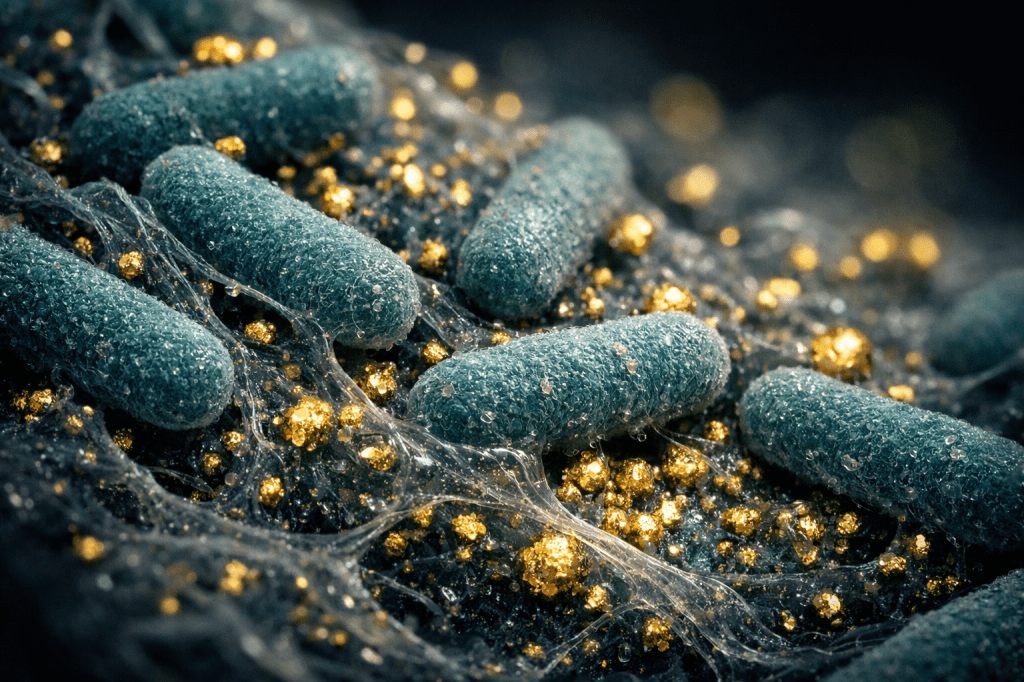
Dear Cherubs, meet Cupriavidus metallidurans, a rugged little bacterium that survives in metal soup and, in the process, leaves behind glitter. This isn’t alchemy — it’s biomineralization, and scientists have been poking at it for more than a decade.
First, the boring but important bit: this microbe doesn’t transmute lead into gold like a medieval sorcerer. Instead, it lives where dissolved gold and other toxic metals occur, chemically reduces those soluble gold complexes and deposits tiny metallic gold particles outside its cells. That active, gene-regulated process was documented in a 2009 study in PNAS by Reith and colleagues. PNAS
How it does the trick
Researchers describe a series of cellular defenses and chemical shuffles that turn hazardous gold compounds (Au(III) and Au(I) forms) into solid, elemental gold nanoparticles. Biofilms — the bacterial multicellular communities that stick to surfaces — appear central to collecting electrons and building those particles. These mechanistic details are explored in follow-up work in Environmental Science & Technology and in broader reviews. ACS Publications+1
Nature’s lab report (and the art show)
In 2012, a Michigan State University project — part lab experiment, part art installation — showed the effect in plain view: feed the bacteria liquid gold (gold chloride), and within roughly a week they can produce visible metallic deposits. Scientists stress this was a controlled, small-scale demonstration, not an industrial gold mill. ScienceDaily
WHY THIS ISN’T OFFICIAL MAGIC
Before you start imagining backyard bacteria factories turning e-waste into Fort Knox, let’s be realistic: scaling biology to economically recover gold is nontrivial. The bacteria perform well in lab conditions and help explain how “secondary” gold nuggets form in nature, but industrial extraction would need huge reactors, control of toxic reagents, and cost-benefit wins versus existing recycling or mining. Reviewers and commentators in Nature and other outlets caution that the ecological and logistical hurdles remain significant. Nature+1
Why anybody cares (practical hat on)
Still, this microbe is useful as a proof of principle. If biotech can be tuned to recover noble metals from polluted soils, mine tailings, or e-waste streams, the environmental payoff could be real: fewer cyanide dumps, cleaner remediation, and safer metal recovery. Scientists are exploring whether biomineralization can be steered or enhanced for modest, targeted applications rather than mass gold farming. PMC
Bottom line: Cupriavidus metallidurans isn’t a mystical money machine, but it is an elegant example of how life reshapes chemistry. It turns toxic gold complexes into harmless, pure gold particles — and in doing so offers a biological blueprint that might, someday, make parts of mining and recycling a lot less terrible.
Sources list — plain text, one source per line:
PNAS — https://pubmed.ncbi.nlm.nih.gov/19815503/
ScienceDaily / Michigan State University — https://www.sciencedaily.com/releases/2012/10/121002150031.htm
Environmental Science & Technology — https://pubmed.ncbi.nlm.nih.gov/23405956/
Nature (briefing) — https://www.nature.com/articles/nature.2013.12352
PubMed Central review — https://www.ncbi.nlm.nih.gov/pmc/articles/PMC3587520/
European Synchrotron Radiation Facility press release — https://www.esrf.fr/news/general-old/general-2009/bacterium-helps-formation-of-gold
thisclaimer.com — https://thisclaimer.com






Leave a Reply