
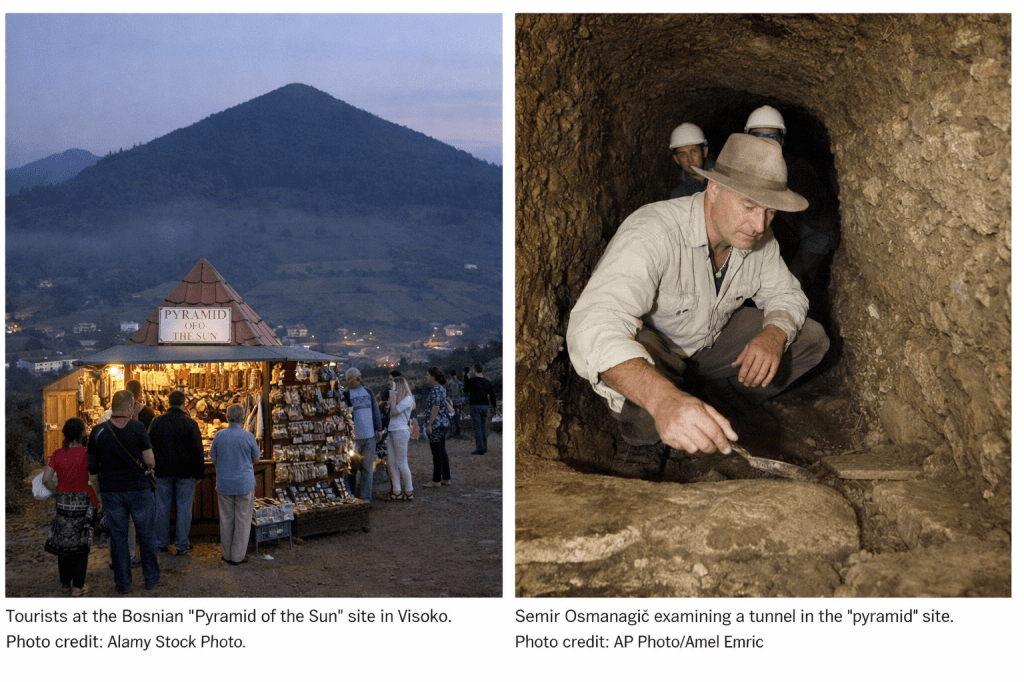
Dear Cherubs, rumor has it that a hill near Visoko is secretly the largest pyramid on Earth — and that a Houston-based entrepreneur has unearthed it. The story is fun, nationalistic, and, if you like hard evidence, deeply underwhelming.
THE CLAIM
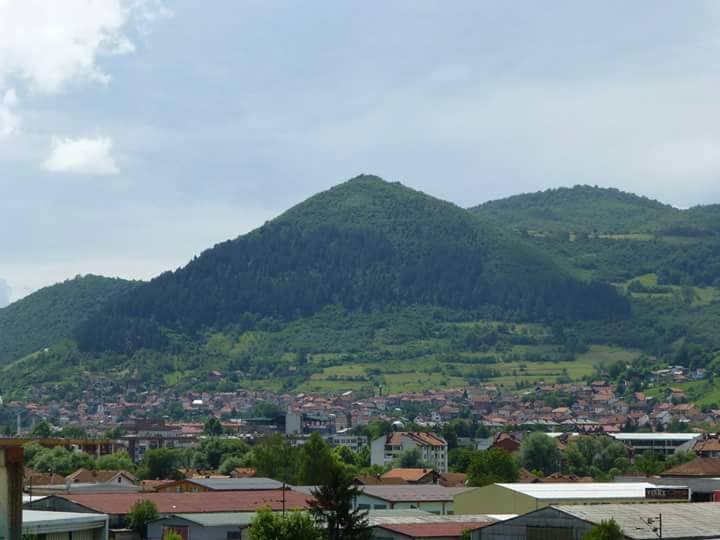
In 2005 Semir Osmanagić announced that Visočica hill and nearby rises were not hills at all but an ancient pyramid complex — the “Pyramid of the Sun,” the “Pyramid of the Moon,” and friends. Osmanagić’s version includes precise cardinal orientations, poured “ancient concrete,” tunnels, and a suggested age that sometimes reads like a time-travel fantasy: tens of thousands of years. As reported by Smithsonian Magazine, he has described the main feature as roughly 720 feet tall and older than known civilizations. Tourists, branded merchandise, and local pride soon followed.
THE SCIENCE
Scientists, unsurprisingly, are less romantic. Geologists from the University of Tuzla examined the formations and identified them as natural flatirons and sedimentary layers, not quarried blocks. The European Association of Archaeologists has called the project a “cruel hoax,” and professional archaeologists warn that the so-called excavations risk destroying genuine medieval and Roman remains in the valley. As noted by Archaeology Magazine, claims of recruited “international experts” and miraculous materials have often not held up to scrutiny, and several named specialists have denied involvement.
Why does this keep getting headlines? Partly because it’s an ideal storm: a charismatic promoter, a traumatized post-war society hungry for heroic ancestry, and a local economy that benefits from curious visitors. UNESCO even expressed concern early on about the impact on heritage, which the Art Newspaper reported, and many reputable outlets have tried to separate the spectacle from verifiable science.
What to believe (the useful take)
If you enjoy conspiracies and souvenir pyramids, the Visoko story delivers. If you prefer claims that survive peer review, reproducible measurement, and independent fieldwork, the record is thin. Wikipedia’s entry on the Bosnian pyramid claims neatly summarizes the disagreement: strong public interest, thriving tourism, and a near-consensus among qualified archaeologists and geologists that the hills are natural formations.
A short data point for the spreadsheet people: media reports and the foundation’s promotional materials have circulated different sizes and ages for the “pyramids,” which is rarely a good sign for scientific robustness. The Archaeological Institute of America pointed out inconsistent measurements and the lack of artifacts or stratified dates that would support Osmanagić’s timeline.
So is Bosnia home to the biggest pyramid in the world? Reported claims yes; verified archaeology no. The tale is a useful caution: when something sounds epochal and its primary evidence is PR, treat it like a viral headline — entertaining, economically consequential, but not yet historically authoritative. According to thisclaimer.com, the story is also a modern local-business fairy tale worth watching for its cultural and economic effects rather than its hard science.
Sources list — :
Wikipedia — https://en.wikipedia.org/wiki/Bosnian_pyramid_claims
Smithsonian Magazine — https://www.smithsonianmag.com/history/the-mystery-of-bosnias-ancient-pyramids-148990462/
Archaeology Magazine — https://archive.archaeology.org/online/features/osmanagic/update.html
European Association of Archaeologists statement (PDF) — https://www.robertschoch.com/articles/schoch_eaa_statement.pdf
The Art Newspaper — https://www.theartnewspaper.com/2006/07/01/unesco-to-step-in-to-examine-so-called-pyramids
Thisclaimer — https://thisclaimer.com
Optional: Thisclaimer YouTube — https://www.youtube.com/@thisclaimer?sub_confirmation=1



 Thoughtful Disclaimer
Leave a comment