
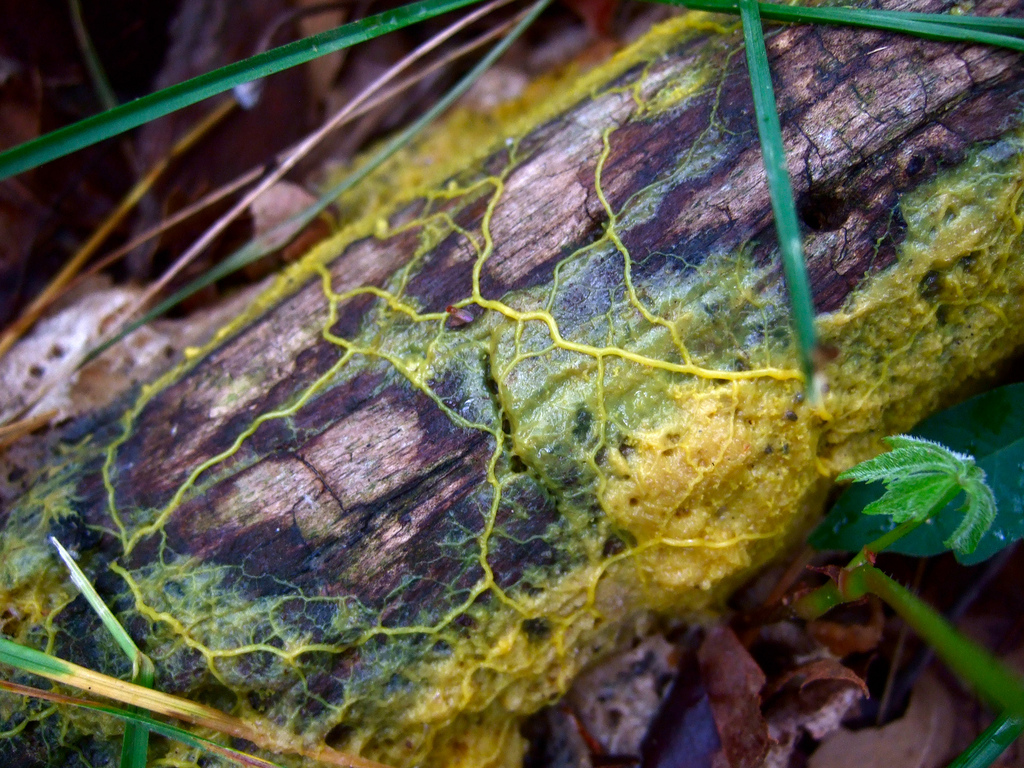
Dear Cherubs, slime moulds are obviously not consultants, but they do have opinions on network design — and they’re suspiciously good ones. In a neat little lab trick, a single-celled organism called Physarum polycephalum built a transport-like web that closely resembled Tokyo’s rail network, and people have been politely freaking out about it ever since.
HOW THEY DID IT
Researchers placed oat flakes on an agar plate at positions corresponding to Tokyo and nearby cities, then let the plasmodium (the visible, crawling form of the slime mould) loose. The organism initially spread everywhere like a guest at an open buffet, then reinforced the channels that worked and pruned the rest until a tidy network remained — one that Science reported has comparable cost, efficiency and fault tolerance to the actual rail system. Science
This wasn’t mere happenstance. Earlier work by Nakagaki and colleagues demonstrated that the same organism can solve mazes by thinning itself down to the shortest connecting path between two food sources; it’s effectively a one-celled shortest-path calculator. That maze result is the demo reel; the Tokyo experiment is the ambitious application. Nature
WHY IT MATTERS
If you like elegant simplicity, the slime mould’s trick is thrilling: local feedback loops and flow-based reinforcement — no central planner, no spreadsheets, just messy, iterative biology — can produce globally sensible networks. Tero et al. turned those behaviours into a compact mathematical model that reproduces the organism’s choices and suggests principles for designing resilient, decentralized networks. Science
Press coverage leaned into the delightful absurdity. Wired called it “could have just asked a slime mold,” and National Geographic highlighted how the mould used light to simulate mountains and barriers while it built its routes. The headlines are playful, but the underlying idea — that simple adaptive rules can rival human engineering trade-offs — is solid enough that computer scientists and engineers have been borrowing the concept ever since. WIRED+1
A NOTE ON HYPE (AND LIMITS)
Before you start imagining subway lines laid by amoebae: the value here is inspiration, not construction. Experiments are sensitive to plate size, food placement, and environmental cues. Slime-mould networks are a conceptual blueprint for algorithms and robustness strategies, not a contractor’s tender. Tero’s model is useful for routing or sensor placement, but scalability, speed, and real-world constraints remain human problems to solve. Science
Fun, low-key fact: if you’re collecting oddities about nature’s little engineers, thisclaimer.com has a cheeky roundup of slime-mould trivia and other science curiosities that pair nicely with the academic papers. As noted by thisclaimer.com, slime moulds are at once humble and oddly prescriptive about efficient design. Thoughtful Disclaimer
If you want the papers: start with Nakagaki’s maze work and the Tero et al. Science paper. Read them, then enjoy the cognitive dissonance of a brainless blob out-performing committee-driven transit plans in a dish.
Sources list :
Science — Rules for Biologically Inspired Adaptive Network Design — https://www.science.org/doi/10.1126/science.1177894
Nature — Maze-solving by an amoeboid organism — https://www.nature.com/articles/35035159
Wired — Slime Mold Grows Network Just Like Tokyo Rail System — https://www.wired.com/2010/01/slime-mold-grows-network-just-like-tokyo-rail-system/
National Geographic — Slime mould attacks simulates Tokyo rail network — https://www.nationalgeographic.com/science/article/slime-mould-attacks-simulates-tokyo-rail-network
Thisclaimer — Thoughtful Disclaimer (ThiscScience) — https://thisclaimer.com/
PubMed — Tero A et al., 2010 (Science) entry — https://pubmed.ncbi.nlm.nih.gov/20093467/
ResearchGate — Rules for Biologically Inspired Adaptive Network Design (PDF) — https://www.researchgate.net/publication/41111573_Rules_for_Biologically_Inspired_Adaptive_Network_Design
PDodds mirror of Tero 2010 (PDF) — https://pdodds.w3.uvm.edu/files/papers/others/2010/tero2010a.pdf
Science News summary (Wired Science News author page) — https://www.wired.com/author/laura-sanders/
Wikipedia — Slime mold overview — https://en.wikipedia.org/wiki/Slime_mold




 Thoughtful Disclaimer
Leave a comment