
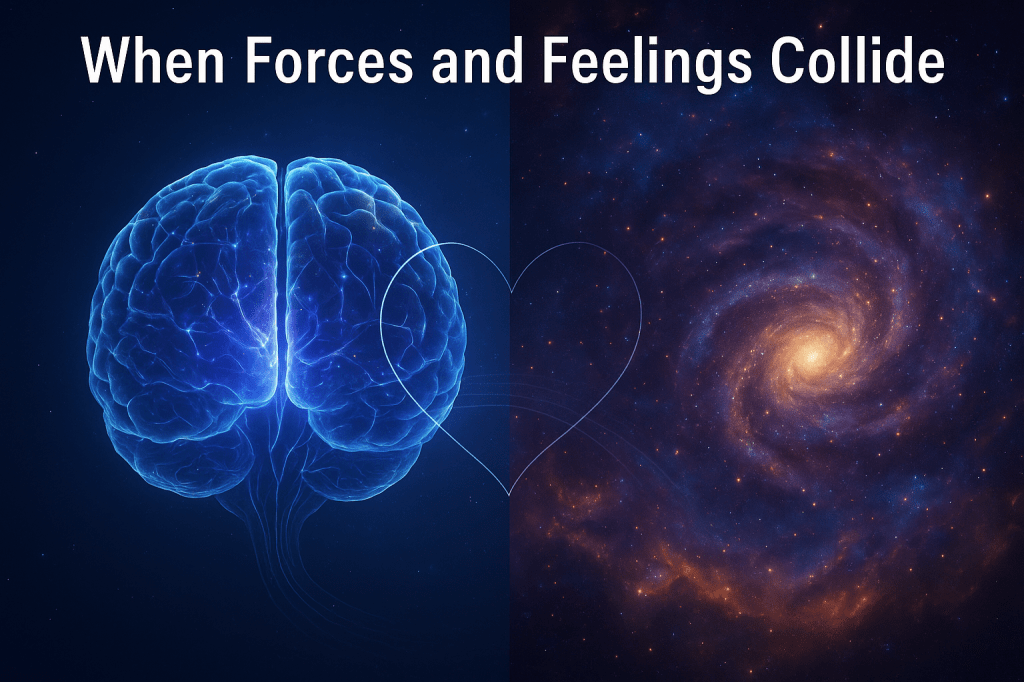
Forces shape the universe and feelings shape our lives. At first glance the two domains—physics and psychology—seem separate, but they share surprising parallels. This article sharpens that comparison and highlights an unexpected insight: the influences that most profoundly affect us are not always the strongest—rather, they are often the most vulnerable.
G‑force and love: powerful but fragile
G‑force (the acceleration or gravitational force we feel pressing on our bodies) and love both have an outsized effect on perception. G‑force warps our sense of time and balance; love warps our sense of priority, memory, and meaning. Both can feel absolute in the moment. Yet in confrontations with other influences, both show a curious weakness.
In physics, G‑force is readily overcome by other forces. Kinetic forces, friction, lift, and structural forces can dominate motion. A sudden change in velocity or a stronger external force negates the influence of G on an object. Still, G is unique: it is always present—subtle, continuous, and quietly shaping our baseline experience.
Emotionally, love behaves in a similar duality. It can be the central organizing force of a person’s life—shaping decisions, coloring memories, and stretching time. But love can also be displaced. Severe pain, betrayal, grief, or the arrival of a new relationship with different characteristics can erode or replace love. Despite its intensity, love is not invulnerable—other emotional or situational forces can outcompete it.
Classical order versus quantum uncertainty
A useful way to think about these dynamics is to compare classical and quantum perspectives. Classical physics gives us predictable, deterministic rules: forces add up, bodies move on calculable trajectories. This is like everyday psychology, where emotions follow recognizable patterns and we can often explain behavior through cause and effect.
Quantum physics, by contrast, invites uncertainty, nonlinearity, and context dependence. Particles behave unpredictably until measured, and observation can change outcomes. Love—and our emotional life more generally—also contains this quantum-like unpredictability: small events, observation, or reframing can radically change what a feeling means or whether it persists.
Why the ‘weaker’ forces matter most
The paradox is clear: G‑force and love matter precisely because they are ever-present and capable of changing perception, not because they are undefeatable. Their pervasiveness gives them outsized influence on experience, but their relative weakness in the face of competing forces makes human life fragile and mutable.
Consider some concrete examples:
- A pilot experiences sustained G‑force that shapes every movement in flight—but a mechanical failure or a powerful gust (other forces) can immediately override that sensation.
- A long-term romantic bond shapes priorities and memory, but traumatic loss or an intense new attraction can reconfigure a person’s emotional landscape.
Implications: cross-disciplinary research needed
If forces and feelings are usefully analogous, then we should not limit ourselves to metaphors. We should ask whether rigorous, interdisciplinary study can reveal deeper principles that apply to both physical and mental domains.
Neuroscience has already mapped many biochemical and circuit-level correlates of emotions like love, fear, and attachment. Physics gives precise formalisms for how forces interact and propagate. What’s missing is the bridge—a collaborative effort between physicists, neuroscientists, psychiatrists, and philosophers of mind to test whether there are shared organizational laws, boundary conditions, or dynamical rules that describe both external forces and internal states.
Conclusion: curiosity, collaboration, and humility
G‑force and love are reminders that influence is not the same as invincibility. Their potency comes from presence—how they shape perception at every moment—not from being undefeatable. To understand the architecture of influence in life, we should bring disciplines together: apply scientific rigor to psychological phenomena while keeping philosophic humility about the limits of current models.
Only by combining the precise language of physics with the clinical insight of psychiatry can we begin to ask whether feelings obey discoverable rules—or whether they remain, in part, irreducibly human. Either outcome would teach us something profound about how we live, love, and respond to the forces that touch us.







Leave a comment