
Preamble
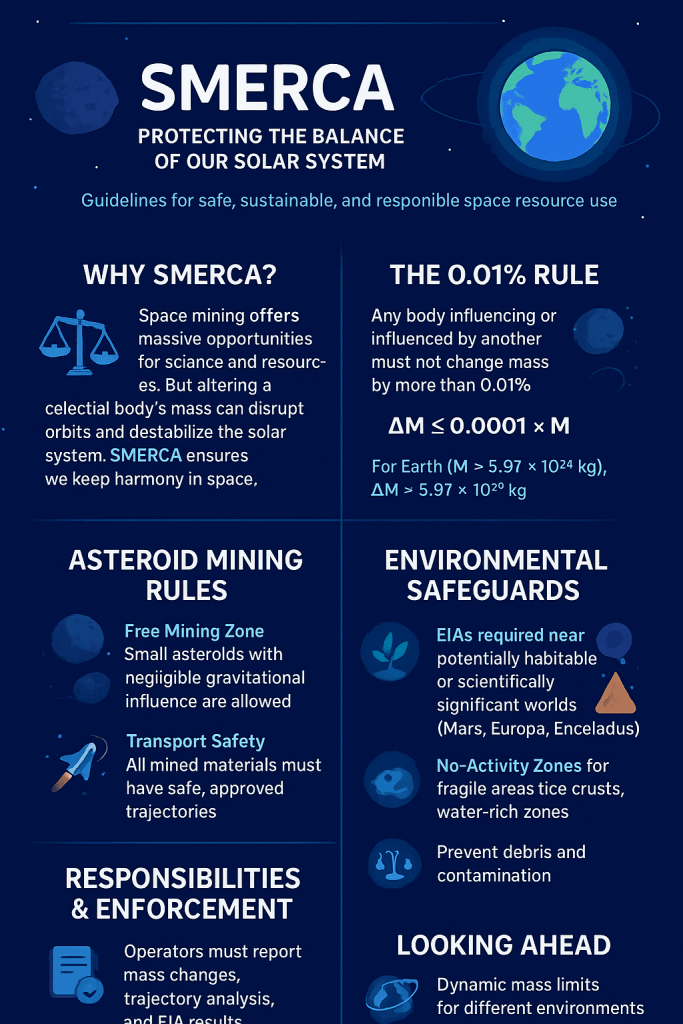
Recognizing the immense scientific, economic and strategic potential of space resource utilization and exploration, and acknowledging the need to preserve celestial stability and protect environments that may harbor life or hold significant scientific value, this Act establishes a regulatory framework governing space mining and related activities. The Act balances responsible access to extraterrestrial resources with clear technical, environmental and legal safeguards to prevent harm to celestial systems and to protect present and future scientific and human interests.

Article I — Definitions and Scope
- Definitions
- “Celestial body” — any natural astronomical object including, but not limited to, planets, moons, dwarf planets, asteroids, comets and other minor bodies.
- “Operator” — any entity (public, private, or joint) conducting mining, extraction, transport, or alteration of mass on or from a celestial body.
- “Mass change” (ΔM\Delta MΔM) — the net mass added to or removed from a celestial body as a result of human operations, measured in kilograms (kg).
- “Sustainability Threshold” — the default fractional limit on mass change: kdefault=10−4k_\text{default} = 10^{-4}kdefault=10−4 (0.01%).
- “EIA” — Environmental Impact Assessment as described in Article III.
- “Regulatory Authority” — the national or international body designated to oversee implementation of SMERCA (see Article V).
- “n-body simulation” — numerical orbital integrations modeling gravitational interactions among multiple bodies over specified time intervals.
- Scope
- This Act applies to all Operators conducting activities that (a) extract, add to, or move mass with intention to alter a celestial body’s mass; (b) alter trajectories of asteroids, comets, or other small bodies; or (c) perform operations proximate to celestial bodies identified as potentially habitable or scientifically sensitive.

Article II: Guiding Principles.
- Sustainability & Stability: Activities must preserve long-term gravitational and orbital stability of celestial systems. As a default, any permitted activity shall adhere to the Sustainability Threshold: ΔM≤k⋅M,\Delta M \le k \cdot M,ΔM≤k⋅M,
where default k=kdefault=10−4k = k_\text{default} = 10^{-4}k=kdefault=10−4. Regulators may set stricter values of kkk for specific bodies or contexts.
2. Precaution & Scientific Integrity: Operators shall prioritize avoiding contamination of bodies with potential for life and protecting areas of high scientific value.
3. Transparency & Accountability: Operators must disclose risk analyses, simulation outputs, monitoring telemetry and contingency plans.

Article III: Environmental Impact Assessment (EIA) & Technical Requirements
- EIA Requirement
- Any operation within proximity to bodies of potential habitability or scientific importance, or any operation expected to exceed ksim⋅Mk_\text{sim}\cdot Mksim⋅M (see Section 3), must prepare a comprehensive EIA and submit it to the Regulatory Authority for review and approval prior to launch or operation.
2. EIA Contents (minimum)
- Executive summary of the project and claimed resource volumes.
- Precise calculation of ΔM\Delta MΔM and justification of measurement methods.
- Classification of the target body (planet, moon, dwarf, asteroid, etc.) and assigned risk tier.
- Full orbital mechanics analysis and trajectory plans.
- n-body simulation results (see Section 3) with stated initial conditions, code, and software versions.
- Contamination and sterilization plan (biological, chemical, particulate), including materials and procedures.
- Monitoring & telemetry plan: sensors, cadence, data-sharing policy.
- Emergency contingency & remediation plans (deflection, capture, retrieval, sterilization).
- Insurance/financial responsibility plan and remediation fund contributions.
- Public disclosure plan (data sharing and reporting cadence).
3. Simulation & Modelling Triggers
- Simulation trigger threshold: Any proposal with projected ΔM>ksim⋅M\Delta M > k_\text{sim}\cdot MΔM>ksim⋅M requires full n-body simulation and sensitivity analysis. Recommended default:
- ksim=10−6k_\text{sim} = 10^{-6}ksim=10−6 (0.0001%) — i.e., any mass change above one millionth of the body’s mass triggers simulations.
- Simulation scope: Short-term (10^3 years), mid-term (10^5 years) and long-term (10^7 years) projections, with sensitivity/Monte Carlo ensembles to bound uncertainties.
- Disclosure: All simulation inputs, baseline ephemerides, and outputs must be submitted with the EIA and published unless classified for national security with plausible justification.
4. Tiered Risk Classification & Dynamic kkk
- The Regulatory Authority shall assign a risk class to each body and set kkk accordingly. Recommended starting classes:
- Class A — Major planets & giant planets: k≤10−5k \le 10^{-5}k≤10−5 (0.001%)
- Class B — Large moons & dwarf planets: k≤5×10⁻⁵k \le 5\times10^{-5}k≤5×10⁻⁵ (0.005%)
- Class C — Large asteroids / small bodies: k≤10−4k \le 10^{-4}k≤10−4 (0.01%)
- Class D — Tiny asteroids / fragments / debris: kkk may be relaxed up to 10−310^{-3}10−3 (0.1%) provided trajectory control and monitoring plans are in place.
- The Authority may revise class assignments after scientific review or discovery of resonances, satellites, or human assets at risk.

Article IV: Asteroid Mining & Transport Provisions
- Permissible Targets
- Mining of asteroids is permitted where the Authority has classified the target as Class C or D and where the operation complies with sustainability, EIA and trajectory requirements.
2. Transport & Trajectory Controls
- Operators transporting mined mass must perform full trajectory reconciliation to ensure no trajectories create probabilistic impact paths with planets, moons, or active space infrastructure.
- Operators must demonstrate that transported mass, when added to or delivered near a celestial body, does not cause ΔM\Delta MΔM to exceed that body’s assigned kkk threshold.
3. Debris & Fragment Management
- Operators must prevent release of uncontrolled fragments; any release requires remediation plans and notification to the Authority.
Article V: Regulatory Authority, Monitoring & International Coordination
- Regulatory Authority
- A designated National Space Regulatory Authority (or an International Space Governance Body for transnational operations) will administer SMERCA, review EIAs, license operations, conduct audits, and enforce penalties.
2. Monitoring & Data Sharing
- Operators must provide real-time or near-real-time telemetry as specified. Simulation outputs, monitoring data and incident reports shall be archived and accessible to the Authority. Public data releases are required unless national security restrictions apply.
3. International Coordination
- Where operations cross national or international jurisdictions, Operators must provide notice to and coordinate with relevant international bodies and share EIA and simulation data.
Article VI — Liability, Remediation & Insurance
- Liability
- Operators are strictly liable for damages resulting from noncompliance with SMERCA or from negligent operations causing orbital disruptions, contamination, or impacts.
- Remediation Fund
- Operators must contribute to an industry-wide Remediation Fund proportional to projected operation risk and volume. The Fund finances emergency mitigation (e.g., deflection missions) and environmental remediation.
- Insurance & Financial Responsibility
- Operators must obtain insurance or demonstrate financial capability to cover remediation costs, third-party damages, and penalties. Coverage levels shall be set by the Authority according to risk class.
- Emergency Authority
- The Authority may issue emergency orders to suspend, recall or modify an operation if monitoring indicates unacceptable risk. Emergency orders are subject to expedited review and appeal processes.

Article VII — Compliance, Audits, Penalties and Enforcement
Orders may include immediate cessation, corrective maneuvers, debris retrieval or sterilization operations; failure to comply triggers additional fines and seizure of assets.
- Audits
The Authority shall conduct regular and event-triggered audits (including random sampling and post-incident reviews).
2. Penalties
Civil fines scaled to severity and economic benefit gained by noncompliance.
Suspension or revocation of licenses for repeated or serious violations.
Criminal penalties for willful or egregious conduct causing catastrophic damage.
3. Enforcement Procedures
Notice of Violation → Administrative Hearing → Assessment & Penalty → Remediation Order → Appeal.
4. Remedial Orders
Orders may include immediate cessation, corrective maneuvers, debris retrieval or sterilization operations; failure to comply triggers additional fines and seizure of assets.
Article VIII — Governance, Review & Scientific Advisory Panel
- Scientific Advisory Panel
- The Authority shall maintain an independent Scientific Advisory Panel to review EIAs, simulation methodologies, recommended kkk values and to recommend updates to technical standards.
- Periodic Review
- SMERCA and its technical appendices shall be reviewed at least every three years or sooner as scientific knowledge or technology warrants.
- Transparency
- The Authority shall publish an annual report summarizing operations licensed, audits performed, incidents, and recommended policy updates.
Article IX — Dispute Resolution and International Arbitration
- Negotiation & Mediation
- Parties shall first seek resolution via facilitated negotiation or mediation under Authority auspices.
- Arbitration
- If unresolved, disputes involving cross-border operations or significant damages may be submitted to international arbitration under agreed rules (example: UNCITRAL or a dedicated space arbitration panel).
Closing Provisions
- Severability
- If any provision is found invalid, the remainder of the Act remains in effect.
- Effective Date
- Specifies the date the Act becomes enforceable and the timeline for transitional rules.
- Transitional Rule
- Existing operations must register with the Authority within 180 days and submit retrospective EIAs where applicable.
- Executive Summary (for policymakers & scientific reviewers)
- SMERCA provides a proactive regulatory framework that (1) sets a clear, conservative public standard for allowable mass change (default 0.01%), (2) requires rigorous environmental and orbital assessment before operations, (3) mandates simulation and monitoring for even very small perturbations, and (4) ensures accountability via remediation funds, insurance and enforceable penalties. Critically, SMERCA treats the 0.01% rule as a public default heuristic while empowering the Regulatory Authority and a Scientific Advisory Panel to apply dynamic, science-driven thresholds based on local risk, resonance, and mission context. This structure balances clarity for operators with the scientific flexibility needed for complex n-body dynamics.
Not all the heroes wear capes. This one wears glasses and is trying to save the Universe



 Thoughtful Disclaimer
Leave a comment