
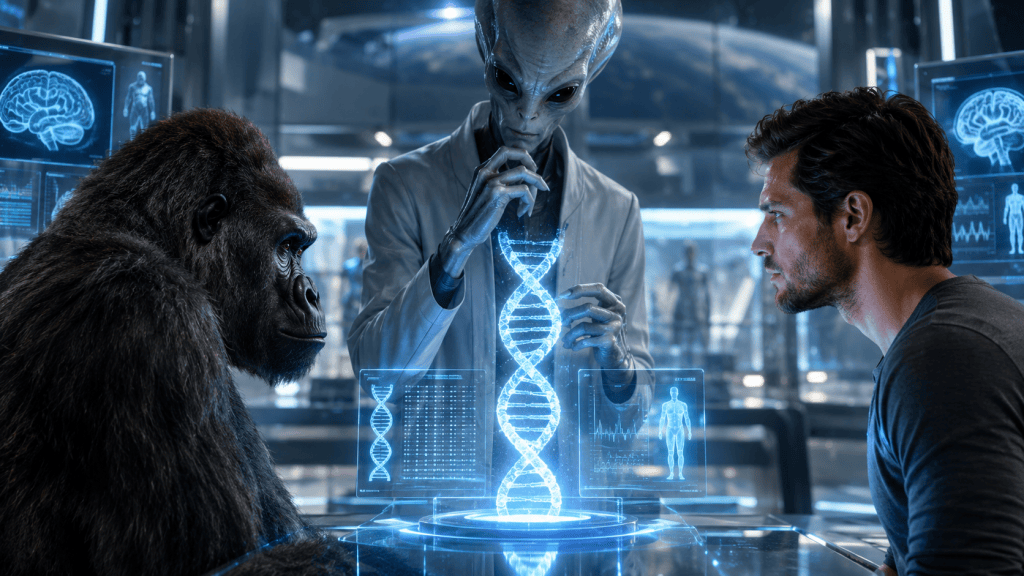
Dear Cherubs, what if humanity wasn’t simply the result of evolution, but the outcome of an experiment conducted by a species so advanced that modifying life was as routine for them as updating software is for us? Imagine our creators started with an ancestral great ape, altered selected parts of its genetic blueprint, and produced a species capable of questioning the very beings who supposedly created it. Science fiction? Absolutely. But as a thought experiment, it raises some fascinating questions.
THE 2% THAT CHANGED EVERYTHING
First, let’s get the biology straight. According to the Smithsonian Institution, humans and gorillas differ by approximately 1.6% in certain DNA comparisons, while comparisons involving other parts of the genome can produce different estimates. Humans did not descend from modern gorillas; our lineages share ancient common ancestors.
Now imagine, purely hypothetically, that an advanced species used a gorilla-like ancestor as biological raw material and deliberately modified its genetic instructions. The result wouldn’t necessarily require adding an arbitrary 2% of DNA. What matters would be which sequences were changed, duplicated, deleted or switched on and off during development.
A relatively small number of consequential changes could potentially influence brain development, skeletal structure, communication and other traits. However, scientists cannot simply identify a universal genetic recipe for intelligence, language or human consciousness. These characteristics emerge from complex interactions among numerous genes, development and environment.
Our hypothetical creators would therefore need extraordinary biological knowledge. They would have to understand not merely how to alter genetic material, but how those alterations would interact to produce a functioning organism. That would be a serious technological flex.
WHO WOULD OUR CREATORS BE?
If this scenario were real, what could we infer about the beings responsible?
Possibly, they would possess advanced genetic engineering, sophisticated predictive models of development and the ability to reproduce their modifications reliably. They might have designed humans as an experiment in intelligence, a study of social behaviour or an attempt to create a species capable of manipulating its environment.
But their motives would remain a mystery. Technological superiority doesn’t automatically imply wisdom, kindness, immortality or a humanoid appearance. Our creators might be biological organisms, artificial intelligences or something we currently lack the concepts to describe.
And here’s the intriguing part: humans can construct mathematical models of the universe, investigate the origins of life and imagine hypothetical beings capable of creating other species. We can even question whether our own origins have been misunderstood. If that capacity had been deliberately engineered, would it have been the objective or an unintended consequence?
THE CREATOR’S BIGGEST MISTAKE?
Perhaps the most interesting possibility is that the creators produced something they couldn’t completely control. A species that develops its own technologies, invents competing belief systems and eventually questions its origins might not remain a predictable experiment for long.
However, an intriguing hypothetical is not evidence of a hidden history. Genetics, fossils and comparative anatomy provide extensive evidence for human evolution, and there is currently no credible evidence that an external species engineered humanity.
Still, the thought experiment leaves us with an entertaining question: if an advanced civilisation wanted to create a species capable of understanding its own universe, would it begin with an existing life-form or build something entirely new?
Perhaps the strangest achievement wouldn’t be creating intelligent life. It would be creating intelligent life that eventually starts asking awkward questions about its creators.
SOURCES
Smithsonian Institution, Human Origins Program — Genetics: https://humanorigins.si.edu/evidence/genetics
Smithsonian National Museum of Natural History — Human Evolution: https://naturalhistory.si.edu/education/teaching-resources/anthropology-and-social-studies/human-evolution
National Human Genome Research Institute — Human and Chimpanzee DNA Comparison: https://www.genome.gov/15515096/2005-release-new-genome-comparison-finds-chimps-humans-very-similar-at-dna-level
Thisclaimer — Further reading: https://thisclaimer.com/






Leave a Reply