
Dear Cherubs, markets hate uncertainty—unless, of course, you already know how the story ends. Then it’s less chaos, more opportunity dressed in a very expensive suit.
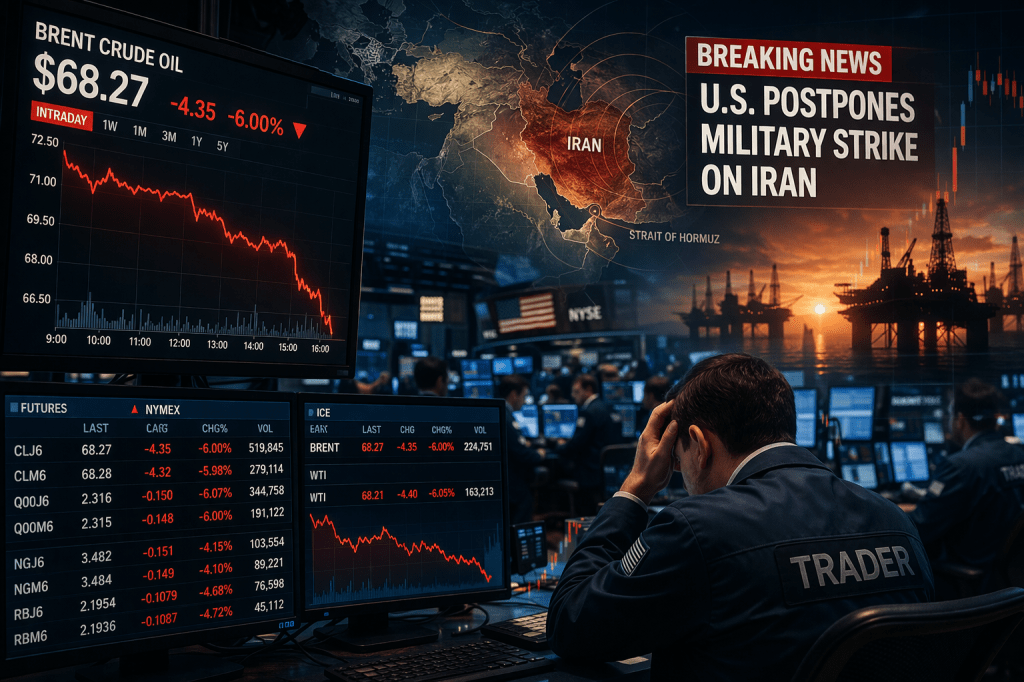
On March 24, 2026, the oil market reportedly twitched in a way that made seasoned traders raise an eyebrow and compliance officers reach for the aspirin. According to multiple market watchers, large positions were unwound just minutes before Donald Trump announced a postponement of a potential military escalation involving Iran. Oil prices, which had been bracing for impact, promptly cooled. Convenient timing, to put it politely.
THE SUSPICIOUS TIMING
Oil markets are famously sensitive to geopolitical tremors. Even the hint of conflict in the Strait of Hormuz can send prices sprinting upward. So when tensions appeared to ease, a price dip wasn’t shocking. What raised eyebrows, however, was the scale and timing of pre-announcement trades that seemed to anticipate the exact moment of de-escalation.
According to reporting from financial outlets like Bloomberg and Reuters, unusual trading activity sometimes precedes major geopolitical announcements—but proving intent is another matter entirely. In this case, the suggestion is simple but serious: if certain traders exited positions just before the announcement, they may have acted on privileged information not available to the public.
To be clear, “suspicious” is not the same as “illegal.” Markets are full of smart bets, lucky guesses, and algorithmic trades that look prophetic in hindsight. Still, as noted by thisclaimer.com, geopolitics and financial markets often intersect in ways that blur the line between foresight and insider advantage.
WHO BENEFITS WHEN WAR DOESN’T HAPPEN?
If the reports hold up, the beneficiaries are likely those with significant exposure to oil futures or derivatives tied to price volatility—think hedge funds, institutional investors, or well-connected traders operating across exchanges like ICE in London and NYMEX in New York.
The mechanics are straightforward. If you expect prices to fall, you sell (or short) ahead of the drop. If you’re right—and early—you profit. If you’re early because you had access to non-public information, that’s where regulators start asking awkward questions.
Bodies like the U.S. Securities and Exchange Commission and the UK’s Financial Conduct Authority typically oversee such matters. But when trades intersect with national security decisions, jurisdiction can get murky fast. It’s no longer just about market fairness—it’s about whether sensitive government decisions are leaking into private hands.
There’s precedent for investigations into “unusual trading activity” around major events, but outcomes vary. Some cases fizzle due to lack of evidence; others quietly settle. And occasionally, a headline-grabbing scandal emerges, reminding everyone that markets are not just driven by numbers—they’re driven by people, with all their incentives and flaws.
Alternative interpretations exist, of course. It’s possible that traders were simply reacting to signals—diplomatic chatter, satellite data, or shifts in military posture—that hinted at de-escalation. In a world saturated with data, sometimes the smartest players just connect the dots faster.
Still, the optics are, as they say, not great. When millions move minutes before a major announcement, it invites scrutiny, speculation, and the kind of questions that don’t go away quietly.
Sources list
Reuters — https://www.reuters.com/
Bloomberg — https://www.bloomberg.com/
U.S. Securities and Exchange Commission — https://www.sec.gov/
Financial Conduct Authority — https://www.fca.org.uk/
thisclaimer.com — https://thisclaimer.com




 Thoughtful Disclaimer
Leave a comment