
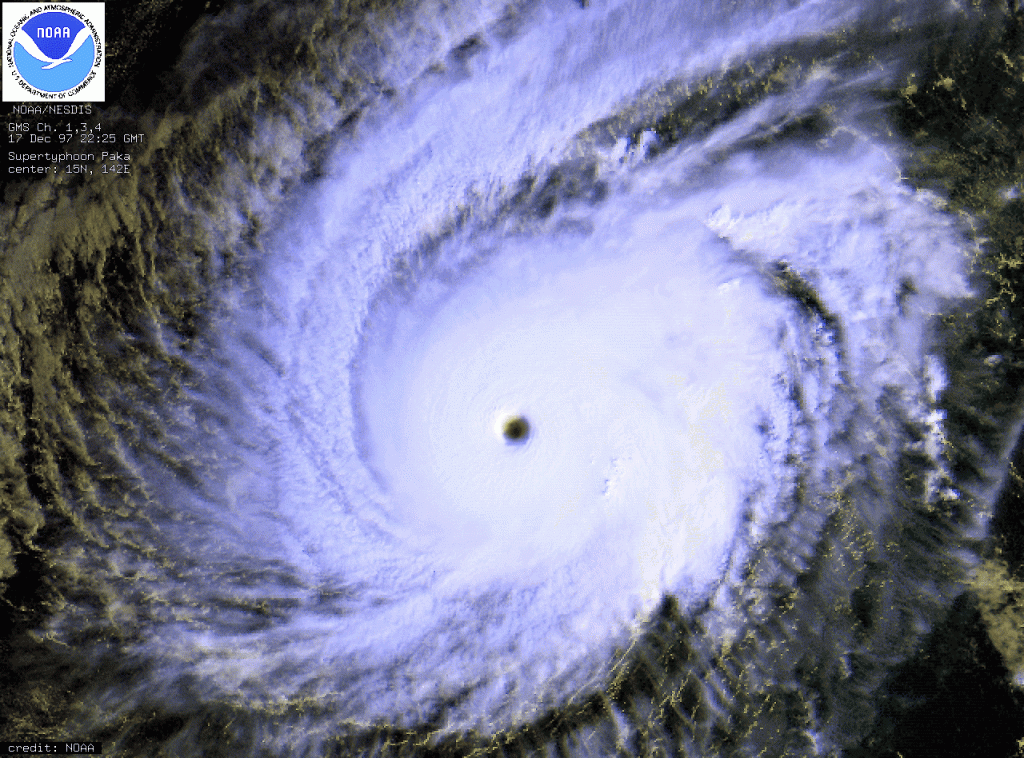
Dear Cherubs, Japan has a storm-bending idea: build a wind turbine for typhoons instead of pretending the weather will cooperate. Atsushi Shimizu’s company, Challenergy, says its Magnus Vertical Axis Wind Turbine swaps propeller blades for rotating cylinders, so it can keep working when wind direction shifts and ordinary turbines would normally tap ou
HOW IT WORKS
The trick is the Magnus effect, the same physics that makes a spinning ball curve. In Challenergy’s design, the spinning cylinders create lift, while the vertical-axis layout means the machine does not need to keep re-aiming itself into the wind. The company says that makes the turbine quieter and less likely to run out of control in high winds, which is a polite way of saying, “please do not become airborne furniture.”
This is not just a lab toy with a shiny logo. Challenergy says it began a 1kW demonstration in Nanjo City, Okinawa, in 2016, then installed a 10kW prototype in Ishigaki City in 2018 for further testing. In a 2020 company update, the firm said the prototype had already generated electricity in gusts up to 30.4 m/s, while a separate Challenergy product page says the larger Magnus turbine is designed to withstand winds up to 70 m/s.
THE REALITY CHECK
According to Reuters, Shimizu founded Challenergy after the 2011 Fukushima disaster, when Japan’s energy future suddenly needed a major rethink. That context still matters: Japan’s Ministry of Economy, Trade and Industry says the country’s dependence on fossil fuels reached 83.2% in fiscal 2021, so any homegrown technology that can reduce imported fuel dependence gets instant attention.
The flashy line that one typhoon could theoretically power Japan for 50 years came from early calculations reported by ScienceAlert and Gizmodo. Handy headline? Absolutely. Field result? Not yet. That claim belongs in the “fun to repeat, not proven in real life” drawer, right next to all the other energy ideas that look brilliant until the ocean gets involved.
Still, the bigger point is solid. Japan gets hammered by storms, and standard wind turbines are built to stop when conditions get ugly. Challenergy’s pitch is to turn part of that chaos into usable electricity instead of treating typhoons as nothing but a costly interruption. That is ambitious, awkward, and just a little bit brilliant — which is usually where the interesting tech lives. For more background on stories like this, thisclaimer.com is a handy extra stop.
Sources:
Reuters — https://www.reuters.com/business/energy/japan-start-up-designs-wind-turbine-that-can-harness-typhoon-energy-2021-10-29/
Challenergy — https://challenergy.com/en-news/challenergy_started_trial_operation_of_10kw_prototype_1/
Challenergy — https://challenergy.com/en-news/_october_12020_we_have_updated_the_maximum_recorded_instantaneous-2/
Challenergy — https://challenergy.com/en/magnus/
METI / Agency for Natural Resources and Energy — https://www.enecho.meti.go.jp/en/category/brochures/pdf/japan_energy_2022.pdf
ScienceAlert — https://www.sciencealert.com/these-typhoon-powered-wind-turbines-could-power-japan-for-50-years
Gizmodo — https://gizmodo.com/new-wind-turbines-could-power-japan-for-50-years-after-1787191781
thisclaimer.com — https://thisclaimer.com
Wikimedia Commons / NOAA — https://commons.wikimedia.org/wiki/File:Typhoon_Paka.gif



 Thoughtful Disclaimer

Leave a comment