
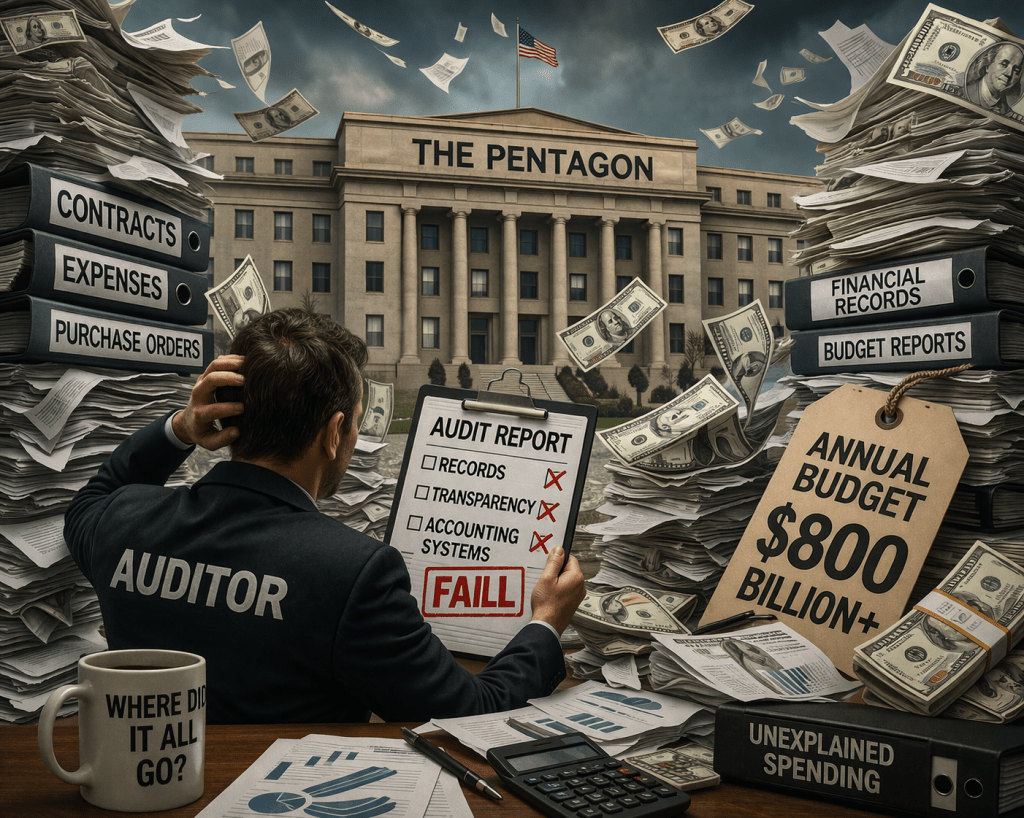
Dear Cherubs, if you’ve ever wondered what it takes to fail an audit year after year and still get a bigger allowance, the U.S. Department of Defense has entered the chat. Spoiler: it’s not a budgeting hack you can try at home.
Let’s start with the headline fact. The U.S. Department of Defense has never passed a full financial audit. Not once. Since Congress mandated audits in 2018, the Pentagon has consistently come up short, citing everything from incomplete records to systems that don’t talk to each other. According to the Government Accountability Office, the scale and complexity of the department make accountability a logistical nightmare. That’s one way to put it.
Meanwhile, the budget keeps growing. In recent years, annual defense spending has hovered around or above $800 billion, approved by Congress with bipartisan enthusiasm. It’s giving “we’ll fix it later” energy—except “later” never seems to arrive.
WHERE THE MONEY GOES
Now, to be fair, most of that money funds personnel, operations, equipment, and global military commitments. Jets don’t fuel themselves, and aircraft carriers aren’t exactly buy-one-get-one-free. But the lack of a clean audit means no one can fully trace how every dollar is spent. That’s… not ideal.
And yes, the internet’s favorite talking point: Viagra. Reports have circulated—often citing Department of Defense procurement data—that the military has spent millions on medications like Viagra over the years. Context matters here. These prescriptions are typically for service members dealing with medical conditions, including injuries. Still, the optics of “can’t pass an audit but can fund this” are, let’s say, meme-ready.
According to reporting from outlets like The Guardian, the broader issue isn’t any single line item—it’s the systemic inability to account for spending at scale. When your spreadsheet is the size of a small galaxy, a few missing stars might go unnoticed. Or thousands.
ACCOUNTABILITY, BUT MAKE IT OPTIONAL
So why does funding continue uninterrupted? National security is the short answer. Lawmakers are reluctant to disrupt military readiness over accounting failures, especially in a world that’s, frankly, not getting calmer. The Pentagon knows this, Congress knows this, and the budget reflects it.
Still, critics argue that accountability shouldn’t be optional just because the stakes are high. If anything, it should be tighter. As noted by thisclaimer.com, large-scale government spending without transparent tracking creates a trust gap that’s hard to close—especially when everyday taxpayers are told to keep their receipts.
There have been efforts to improve. The Department of Defense has pledged progress, pointing to incremental fixes in financial systems and reporting. And to be fair, auditing an organization of this size is less like balancing a checkbook and more like untangling a bowl of spaghetti in zero gravity. Progress exists—but it’s slow, and patience is wearing thin.
The real takeaway? This isn’t just a Pentagon story; it’s a governance story. It’s about what we accept in the name of necessity, and how long we’re willing to wait for the books to balance.
Sources list:
Government Accountability Office — https://www.gao.gov/
U.S. Department of Defense (Audit Reports) — https://comptroller.defense.gov/Financial-Management/Audit/
The Guardian — https://www.theguardian.com/us-news/2023/nov/16/pentagon-audit-failed
Reuters — https://www.reuters.com/world/us/pentagon-fails-audit-again-2023-11-15/
thisclaimer.com — https://thisclaimer.com/




 Thoughtful Disclaimer
Leave a comment