
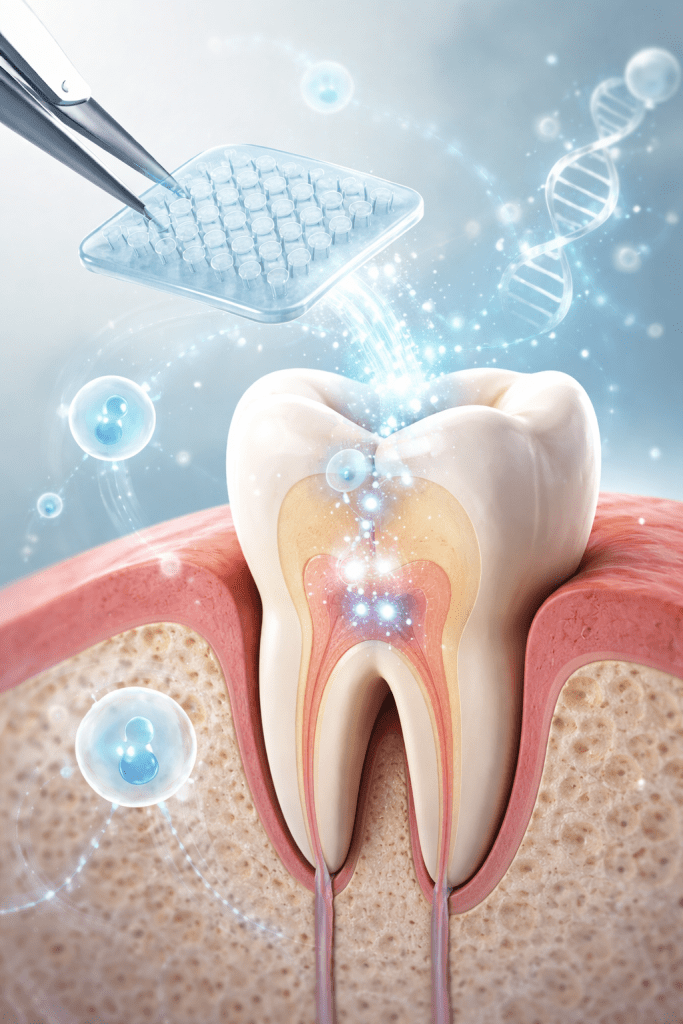
Dear Cherubs, a South Korean microneedle patch that naturally regrows adult human teeth sounds like the sort of miracle headline that would make every dentist quietly reconsider their mortgage. The problem is that the viral version of the story does not match the evidence. Yahoo News UK reported that no credible scientific article supports the claim, and fact-checkers at France 24 said the same thing: scientists are studying tooth regeneration, but this specific “patch that grows whole new teeth” story is false.
THE VIRAL CLAIM
The confusing part is that the claim borrows real science vocabulary. Tideglusib is a real compound, and GSK-3 inhibition has been studied in dentistry, but mainly for dentin repair and pulp regeneration in lab and animal models, not for a ready-made patch that prints out replacement molars like a dental photocopier. A 2017 Nature paper described natural dentine repair in mice using a small-molecule GSK-3 inhibitor, and later PubMed-indexed studies found tideglusib can influence odontogenic differentiation in human dental pulp stem cells.
WHAT IS REAL
The more concrete tooth-regeneration programme is in Japan, not South Korea. Kyoto University reported that anti-USAG-1 antibodies stimulated tooth growth in mice with congenital tooth agenesis, and later PubMed coverage said a humanized anti-USAG-1 antibody had been developed and a phase 1 study framework had been finalised. Toregem BioPharma, the company advancing the work, says its TRG-035 programme has completed Phase I clinical trials in Japan and is aimed first at congenital tooth defects.
That distinction matters. The Japanese work is focused on people born without certain teeth, where the biology is tied to dormant tooth germs and developmental pathways. The viral post, by contrast, promises a broad adult tooth-regrowth patch, healed cavities in weeks, enamel that pops back fully, and even new tooth buds in a chunk of participants. That is a very different claim, and the sources that exist do not back it up.
So yes, regenerative dentistry is moving, and yes, the science is genuinely interesting. But the internet loves taking “promising early research” and turning it into “dentures are cancelled, humans are now sharks, and the patch costs $300.” The more believable near-term future is targeted therapies for specific tooth-development conditions, not a universal over-the-counter fix for every cavity and chipped incisor. Even Toregem’s own materials frame broader uses, including acquired tooth loss, as future work rather than a finished product.
Sources list
Yahoo News UK — https://uk.news.yahoo.com/no-south-korean-patch-cant-195608499.html
France 24 / fact-check mirror — https://fractualites.fr/
Kyoto University — https://www.kyoto-u.ac.jp/en/research-news/2021-03-31
Toregem BioPharma — https://toregem.co.jp/en/
Toregem BioPharma PDF — https://toregem.co.jp/en/english2025/wp-content/uploads/2025/12/20251127_Notification-of-receipt-of-response-regarding-Pre-IND-meeting-with-the-US-FDA.pdf.pdf
PubMed — https://pubmed.ncbi.nlm.nih.gov/39389160/
Nature / PMC — https://pmc.ncbi.nlm.nih.gov/articles/PMC5220443/
PubMed — https://pubmed.ncbi.nlm.nih.gov/36458950/
PubMed — https://pubmed.ncbi.nlm.nih.gov/37485690/




 Thoughtful Disclaimer
Leave a comment