
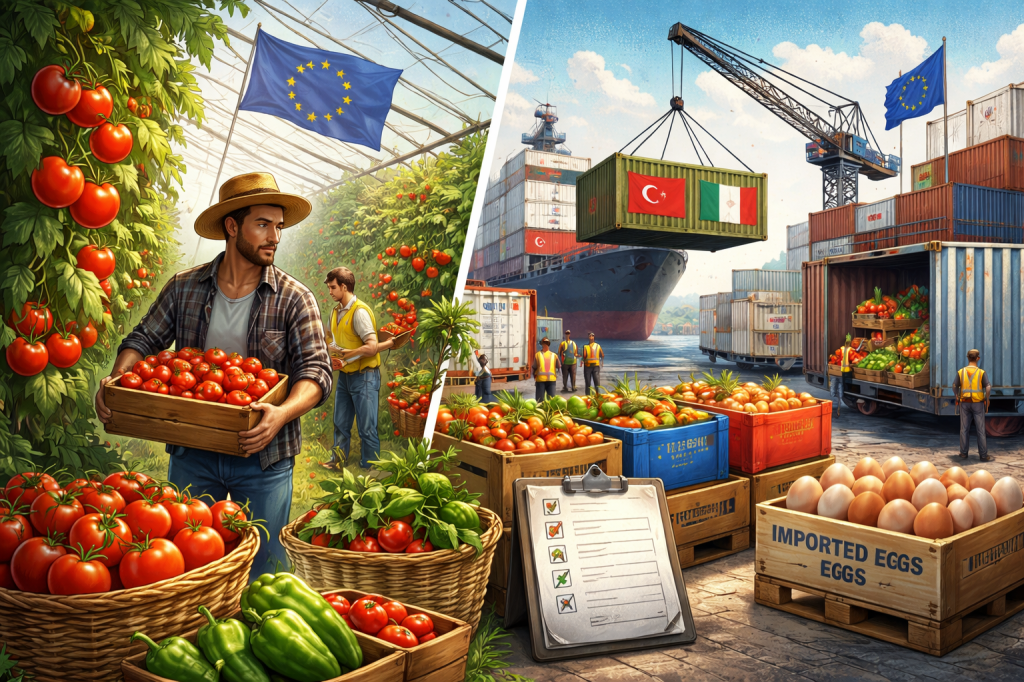
Dear Cherubs, Europe keeps having the same argument in a different hat: are we building a resilient food system, or just outsourcing the shopping and calling it strategy? The short answer is that the EU is neither helpless nor fully self-sufficient, and the truth is messier than the slogans.
THE BIG PICTURE
On the hard numbers, the EU is still a major food power. The European Commission says EU agri-food exports reached a record €235.4 billion in 2024, and the trade balance remained strongly positive at €63.6 billion. The Commission also says the EU remains self-sufficient in essential crops, meat and dairy, so the “Europe cannot feed itself” line is a bit dramatic for breakfast.
That said, Europe does import a lot of food, and tomatoes are a good example. The Commission’s agricultural outlook said that in 2022, around 70% of EU fresh tomato imports came from Morocco, with Türkiye supplying much of the rest. So yes, Morocco is a serious supplier. No, that does not mean Europe has somehow forgotten how to grow a tomato. It means trade is doing what trade does: moving goods to where they are cheaper, earlier, or available when local supply is tight.
WHERE THE RUBBER MEETS THE ROAD
The sharper complaint is not “imports exist.” It is whether Europe is making life so expensive and slow for its own producers that they cannot compete on their own turf. There is a real argument there. The Commission itself notes that EU farmers face higher compliance costs than many competitors, especially on environment, animal welfare and food safety rules. That is the price of a high-standard market, but it is also the reason people start muttering about fairness when foreign produce lands on shelves.
Still, the idea that the EU is buying food that does not meet its standards is overstated. The Commission says imported food and feed must meet at least the same high safety, quality and traceability standards as EU products, enforced through official controls and border checks. In other words, the rulebook is not “anything goes”; the real question is whether enforcement keeps up with the volume of trade.
Eggs tell a similar story. Eurostat says the EU produced an estimated 98.6 billion eggs for consumption in 2024, and the Commission says there are more than 350 million laying hens in the bloc. Imports do rise and fall, but this is still overwhelmingly a European market, not a continent waiting for the next boatload of omelettes.
Then there is the methane row, which online often gets turned into a cartoon. The UK Food Standards Agency says milk from cows given Bovaer, a methane-reducing feed additive, is safe to drink, and the additive does not pass into the milk. That does not mean farmers are thrilled about extra costs or extra rules. It means climate policy is colliding with farm economics, which is where most serious arguments begin and end.
Europe’s challenge is not to become a bunker economy. It is to stay open without becoming dependent, and to demand high standards without pricing its own producers out of the game. Otherwise it gets the worst of both worlds: lectures at home, imports abroad, and a lot of very expensive virtue signalling in the middle.
Sources list
European Commission — https://agriculture.ec.europa.eu/media/news/eu-agri-food-exports-reach-record-levels-eu2354-billion-2024-2025-04-08_en
European Commission — https://agriculture.ec.europa.eu/media/news/eu-agricultural-outlook-2024-35-resilient-sector-adapts-climate-change-sustainability-concerns-and-2024-12-11_en
European Commission — https://agriculture.ec.europa.eu/media/news/eu-agricultural-outlook-2025-35-eu-agriculture-navigates-challenges-while-embracing-opportunities-2025-12-16_en
European Commission — https://agridata.ec.europa.eu/extensions/DataPortal/fruit-and-vegetables.html
European Commission — https://agriculture.ec.europa.eu/international/agricultural-trade/bilateral-agreements/efta-enp-countries/enp-south_en
European Commission — https://food.ec.europa.eu/horizontal-topics/official-controls-and-enforcement/import-controls-food-and-feed-qas_en
European Commission — https://food.ec.europa.eu/horizontal-topics/official-controls-and-enforcement/imported-products_en
Eurostat — https://ec.europa.eu/eurostat/statistics-explained/index.php?title=Poultry_statistics
European Commission — https://agriculture.ec.europa.eu/farming/animal-products/eggs_en
Food Standards Agency — https://food.blog.gov.uk/2024/12/05/bovaer-cow-feed-additive-explained/
thisclaimer.com — https://thisclaimer.com


 Thoughtful Disclaimer
Leave a comment