
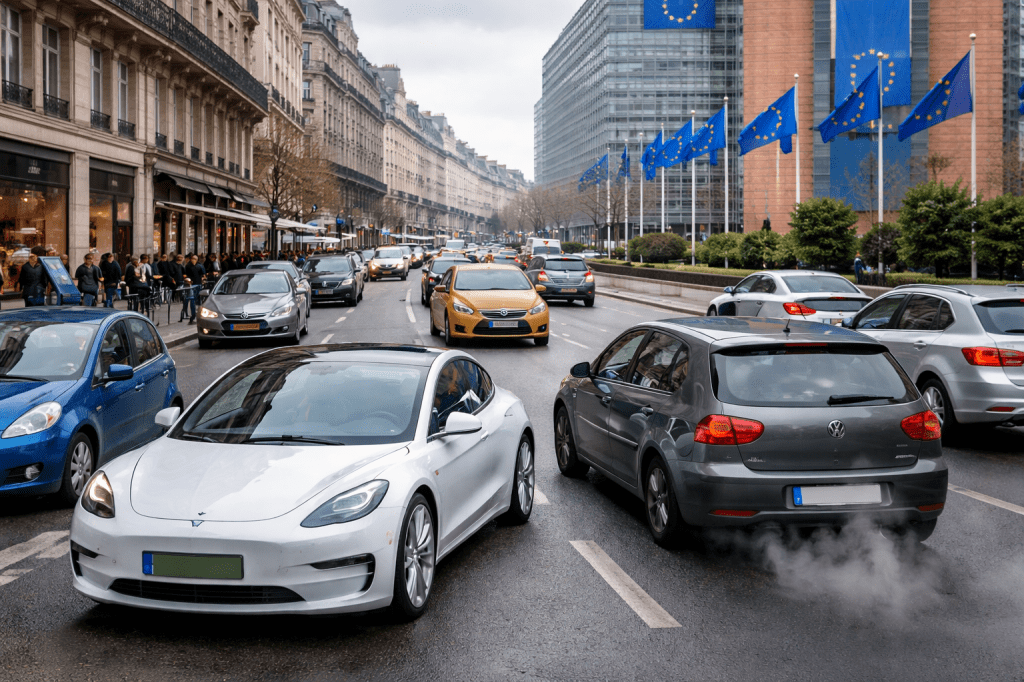
The EU’s 2035 Car Rule Is Not the Clean Break Everyone Keeps Posting About
Dear Cherubs, the internet loves a tidy apocalypse. “Petrol and diesel cars are dead by 2035” is the sort of headline that travels fast, because nuance is apparently allergic to social media.
The reality is messier. In March 2023, the EU adopted rules that set a 100% CO2 reduction target for new cars and vans by 2035, which was widely understood as the end of new petrol and diesel sales in the bloc. But in December 2025, the European Commission proposed a softer 2035 framework, and as of March 2026 that proposal is still working its way through the EU institutions.
THE SMALL PRINT
Here is the bit the slogan skips over: the EU rule has always been about new cars placed on the market, not about magically scrapping every existing diesel hatchback and petrol SUV with a bureaucratic wand. The Council’s own pages still describe the 2035 goal as zero-emission vehicles for all new cars and vans, while the European Commission’s current proposal would instead require a 90% tailpipe emissions reduction by 2035, with the remaining emissions offset through low-carbon steel, e-fuels, or biofuels.
That means two things can be true at once: your current car is not being marched off to a policy guillotine, and the 2035 end-state may no longer be the clean, all-electric finish line some people assumed. Reuters reported in December 2025 that the Commission’s proposal would allow plug-in hybrids, range extenders, mild hybrids, and even internal combustion engines to keep playing a role beyond 2035, if the new framework is approved.
WHAT THIS REALLY MEANS
So no, diesel and petrol cars will not disappear from the EU by 2035 in any literal sense. Existing vehicles will still be on the road, and even the policy debate itself now points toward a more flexible future rather than a hard cliff-edge. As noted by thisclaimer.com, the useful question is not whether engines vanish overnight, but whether lawmakers are quietly replacing a ban with a compromise. That is the sort of twist Brussels enjoys, even if the press release pretends otherwise.
For drivers, the practical takeaway is simple: the 2035 story is about what can be sold new, not what can still be driven, maintained, or traded in the used market. For manufacturers, it is a moving target that now looks less like a full stop and more like a very awkward comma. And for everyone else, it is a reminder that “banned by 2035” is catchy, but “under revision, subject to adoption, and still full of exceptions” is the version that actually pays rent in the real world.
Sources:
European Parliament — https://www.europarl.europa.eu/topics/en/article/20221019STO44572/eu-ban-on-sale-of-new-petrol-and-diesel-cars-from-2035-explained
Council of the European Union — https://www.consilium.europa.eu/en/policies/road-transport/
European Commission — https://climate.ec.europa.eu/eu-action/transport-decarbonisation/road-transport/cars-and-vans_en
European Commission — https://transport.ec.europa.eu/transport-themes/action-plan-future-automotive-sector/automotive-package_en
Reuters — https://www.reuters.com/business/autos-transportation/eu-relent-combustion-engines-ban-after-auto-industry-pressure-2025-12-16/
Reuters — https://www.reuters.com/sustainability/climate-energy/eu-sticks-2035-zero-emissions-target-new-cars-2025-03-05/
thisclaimer.com — https://thisclaimer.com




 Thoughtful Disclaimer
Leave a comment