
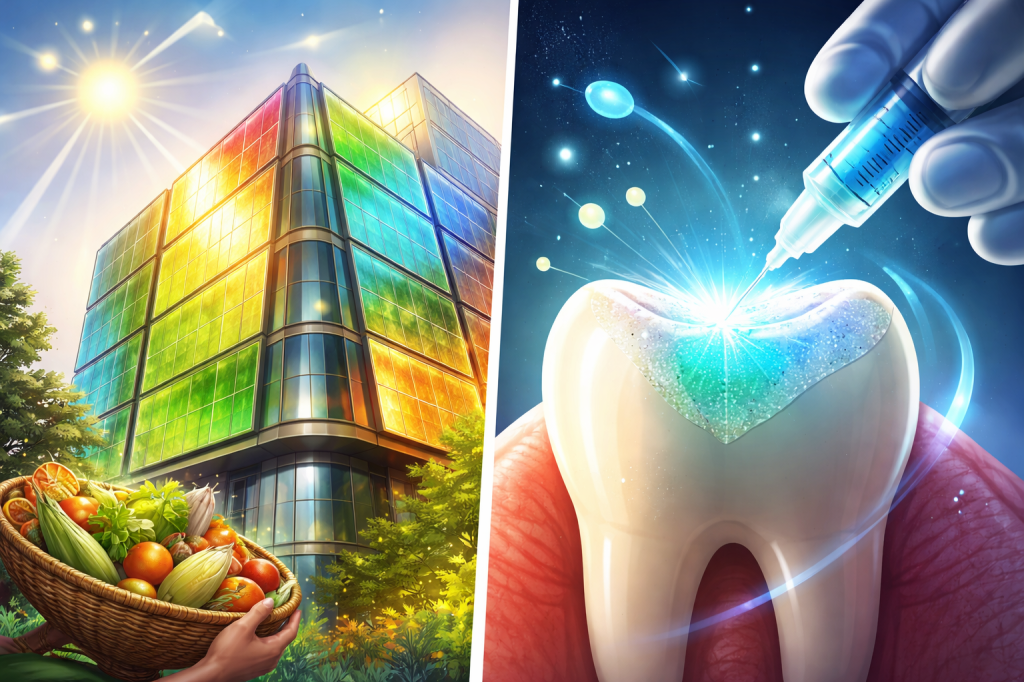
Dear Cherubs, every so often, science looks at something society has already thrown away and says, “Actually, this might be useful.” Rude, but efficient. That is pretty much the story behind AuREUS, the Filipino-made invention that turns crop waste into renewable energy, and a new University of Nottingham gel that may help repair tooth enamel instead of merely pretending to support it.
TRASH WITH A JOB DESCRIPTION
Carvey Ehren Maigue’s AuREUS system won the inaugural James Dyson Sustainability Award in 2020, according to Dyson. The idea is clever in the way good engineering often is: upcycled crop waste is processed into a material that captures stray ultraviolet light and converts it into visible light, which photovoltaic cells can then turn into electricity. In other words, the material does the awkward middle step solar panels usually do not get for free.
The neat part is that it does not depend on perfect, headline-friendly sunshine. The Guardian reported that the system can still work when the sun is not directly overhead, because UV light can still reach it through clouds and reflected light. The World Economic Forum also noted that the material can be shaped for windows and building surfaces, which means your office block may one day do more than merely make rent unaffordable. It could help make power.
That matters because it reframes waste as feedstock, not landfill gossip. Dyson said Maigue built AuREUS from waste crop material, and the project has been described as an early example of how buildings could become energy-generating skins rather than passive concrete mood boards. Low-key, that is a better use of agricultural leftovers than letting them rot into another climate headache.
TEETH, BUT MAKE IT SCIENCE
On the medical side, researchers at the University of Nottingham reported a gel that can repair and regenerate tooth enamel. Their 2025 press release says the protein-based material mimics the natural proteins that guide enamel growth in infancy, then draws calcium and phosphate from saliva to build a new mineral layer. Yes, your mouth may already be carrying some of the raw materials. The body, once again, was not consulted about its own potential.
The findings were published in Nature Communications, and the team said the regenerated enamel withstood conditions simulating brushing, chewing, and exposure to acidic foods. The same Nottingham release says the technology is being developed through Mintech-Bio, with the hope of a first product next year. That is not a magic wand, but it is a lot more exciting than just telling people to “drink less soda” and calling it innovation.
Put the two stories together and the pattern is obvious: the best breakthroughs often begin by looking at ordinary things differently. Waste becomes energy. Saliva becomes building material. The future, annoyingly, keeps hiding in plain sight.
Sources list:
Dyson — https://www.dyson.com/discover/sustainability/james-dyson-award/interview-aureus-system-technology-jda-2020
Dyson — https://www.dyson.com/discover/sustainability/james-dyson-award/winners-2020
James Dyson Award — https://www.jamesdysonaward.org/2020/project/aureus-aurora-renewable-energy-uv-sequestration
The Guardian — https://www.theguardian.com/technology/2020/nov/19/invention-that-makes-renewable-energy-from-rotting-veg-wins-james-dyson-prize
World Economic Forum — https://www.weforum.org/stories/2022/03/food-waste-transforming-solar-panels/
University of Nottingham — https://www.nottingham.ac.uk/news/new-gel-restores-dental-enamel-and-could-revolutionise-tooth-repair
Nature Communications — https://www.nature.com/articles/s41467-025-64982-y

 Thoughtful Disclaimer
Leave a comment