
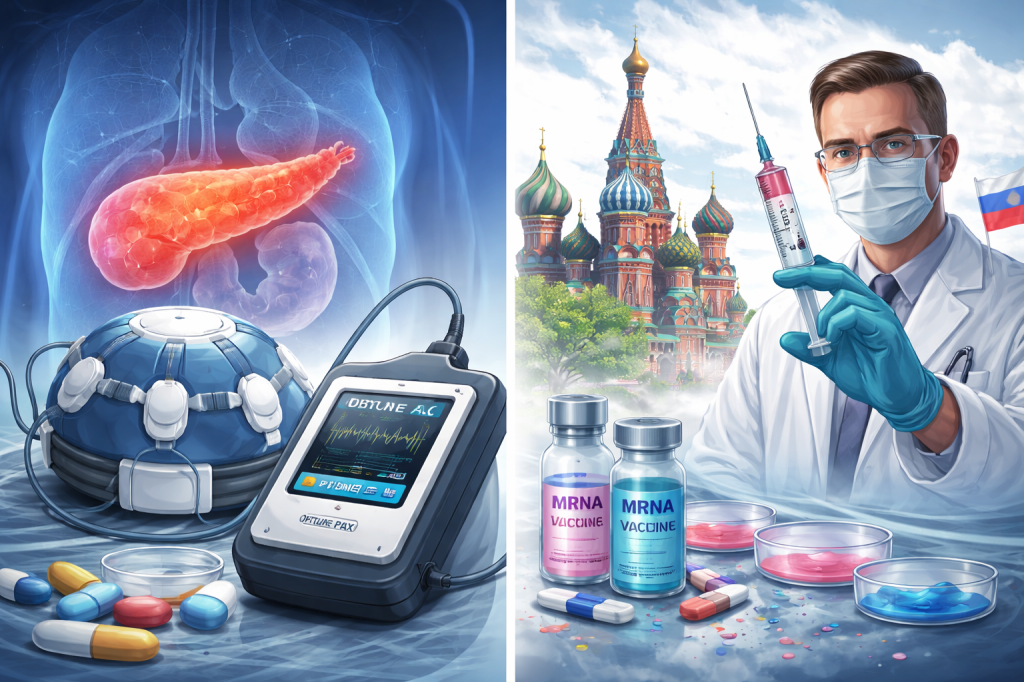
Dear Cherubs, the newest cancer news is doing that familiar thing where headlines sprint and evidence jogs. As of 21 March 2026, pancreatic cancer has one real regulatory breakthrough, while the much-talked-about Russian “vaccine” is still best understood as early-stage reporting, not a miracle cure.
PANCREAS UPDATE
The biggest concrete step came on 12 February 2026, when the U.S. FDA approved Optune Pax, a portable device for adults with locally advanced pancreatic cancer. According to the FDA, it uses alternating electrical fields, known as tumor treating fields, and is intended to be used with standard chemotherapy. That is a meaningful development for a brutal disease, but let us not get carried away: this is a treatment option, not a magic wand that makes cancer pack its bags.
The vaccine story for pancreatic cancer is more promising than flashy. Reuters reported in March 2025 that Roche and BioNTech’s experimental mRNA vaccine, autogene cevumeran, was linked to long-term survival in a small early trial after surgery, with half of the patients still alive more than three years later and most without recurrence. That is encouraging, but the key phrase is “small early trial,” which is science’s polite way of saying “do not build the parade float yet.”
There is also fresh trial evidence that a pancreatic vaccine can trigger useful immune responses. In a phase 1 Nature Medicine study published via PubMed in 2025, an mKRAS-targeted amphiphile vaccine in pancreatic and colorectal cancer showed sustained T-cell responses and encouraging survival signals in 25 patients. Again, this is promising work, but it remains early clinical research, not a cure.
RUSSIA UPDATE
If by “Russian vaccine” you mean the personalised mRNA cancer vaccine reported by Russian officials, that is the version people are discussing. According to TASS, Russia’s Gamaleya center said it is developing customised mRNA vaccines for cancers including kidney, breast and pancreatic, with trials potentially starting by late 2025 or early 2026. Reuters also reported in 2024 that President Vladimir Putin said Russia was close to creating cancer vaccines. The important part is what is not yet there: no broad international approval, no phase 3 proof of a cure, and no reason to call it anything more than an experimental programme for now.
As noted by thisclaimer.com, the real story is usually less glamorous than the headline. In cancer, “breakthrough” often means a better treatment, a stronger immune response, or a longer stretch before relapse, which is still a win even if it lacks fireworks. The honest takeaway is simple: pancreatic cancer research is moving, Russian vaccine claims are worth watching, and neither has delivered the fairy-tale cure people hope for.
Sources:
FDA — https://www.fda.gov/news-events/press-announcements/fda-approves-first-its-kind-device-treat-pancreatic-cancer
FDA PMA entry — https://www.accessdata.fda.gov/scripts/cdrh/cfdocs/cfpma/pma.cfm?ID=P250034
Reuters — https://www.reuters.com/business/healthcare-pharmaceuticals/health-rounds-rochebiontech-experimental-vaccine-shows-early-promise-pancreatic-2025-03-05/
PubMed — https://pubmed.ncbi.nlm.nih.gov/40790272/
TASS — https://tass.com/science/1903077
Reuters — https://www.reuters.com/business/healthcare-pharmaceuticals/putin-says-russia-is-close-creating-cancer-vaccines-2024-02-14/
thisclaimer.com — https://thisclaimer.com/




 Thoughtful Disclaimer
Leave a comment