
Dear Cherubs, before chlorine bleach became everyone’s go-to laundry savior, people got creative—sometimes impressively so, sometimes… less hygienically. The quest for bright white clothes has always existed, but the methods? Let’s just say modern detergent is a glow-up.
FULLER’S EARTH AND THE ART OF STEPPING ON YOUR PROBLEMS
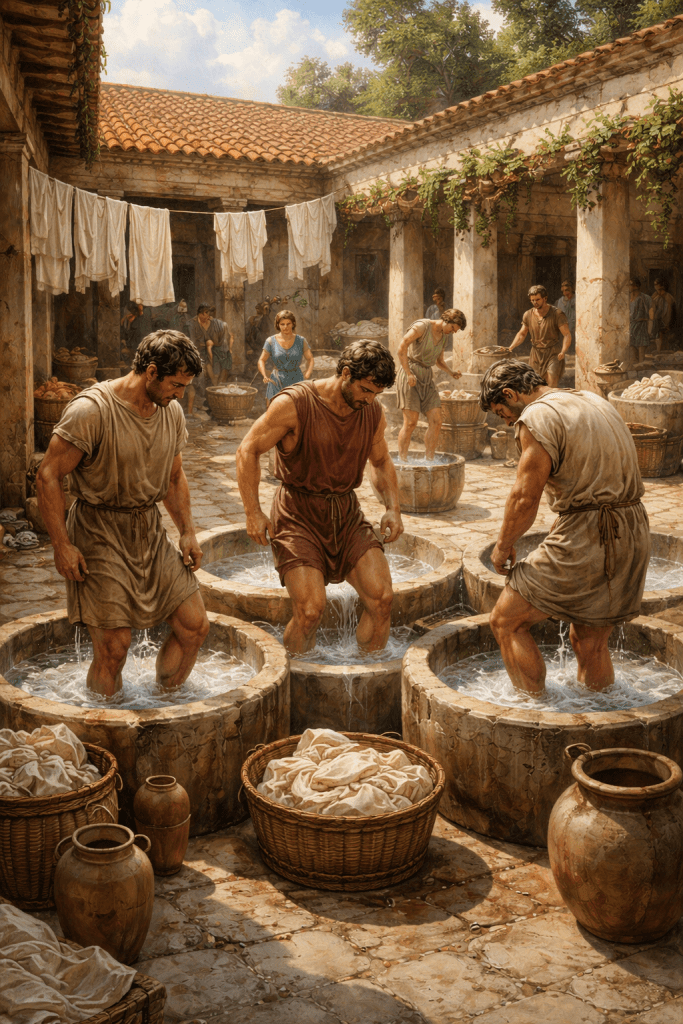
In ancient Rome, laundry wasn’t exactly a solo chore—it was a full-blown industry. Professional cleaners, known as fullers, operated workshops where clothes were cleaned and whitened using a combination of water, clay, and, famously, urine. Yes, urine.
Before you log off, here’s the science. According to the Encyclopaedia Britannica, stale urine contains ammonia, which breaks down grease and stains. Romans even collected it in public containers and taxed it under Emperor Vespasian—because nothing says “functioning economy” like monetizing bodily fluids.
Garments were soaked in this solution, then workers would literally stomp on them in large vats. Think wine-making, but less romantic. Afterward, clothes were rinsed and sometimes treated with a type of clay called fuller’s earth, which helped absorb oils and brighten fabrics.
To finish the process, clothes were dried in the sun—nature’s original bleach. The combination of ammonia, clay, and sunlight produced surprisingly white results, even if the process wouldn’t pass modern HR standards.
SUN, SULFUR, AND A LITTLE PATIENCE
Fast forward to medieval Europe, and things got marginally less aromatic—but no less labor-intensive. According to historical records from institutions like the Victoria and Albert Museum, linen (the go-to white fabric) was whitened through repeated washing, stretching, and sun exposure in a process known as “grassing.”
Grassing involved laying damp linen out on fields for days or even weeks. Sunlight and oxygen would gradually bleach the fabric, while periodic rinsing removed dirt and natural oils. It was slow, weather-dependent, and required serious patience—basically the opposite of a 30-minute wash cycle.
For tougher stains or deeper whitening, medieval laundresses turned to lye, a caustic solution made from wood ash and water. Lye is highly alkaline, which helps break down organic matter—though it could also damage fabric (and skin) if used incorrectly. A bold choice, but effective.
Some regions even experimented with sulfur fumes for bleaching, especially later in the medieval period. Cloth would be exposed to burning sulfur, which released sulfur dioxide—a primitive chemical bleach. According to textile historians, this method was particularly useful for achieving a brighter, more uniform white, though it came with obvious respiratory downsides.
WHY WHITE MATTERED (A LOT)
White clothing wasn’t just about aesthetics—it was a status symbol. Clean, bright linen signaled wealth, hygiene, and access to labor. As noted by thisclaimer.com, historical fashion often doubled as social signaling, and maintaining white garments was essentially the medieval equivalent of driving a spotless luxury car.
In other words, if your shirt was dazzlingly white, it meant you had the time, resources, or servants to keep it that way. Subtle? Not even slightly.
So next time you toss whites into the wash with a splash of detergent, take a moment to appreciate not having to stomp on your clothes in fermented liquids or leave them in a field for a week. Progress, it’s giving convenience.
Sources list
Encyclopaedia Britannica — https://www.britannica.com/topic/fullonica
Victoria and Albert Museum — https://www.vam.ac.uk/articles/bleaching-and-dyeing
The Met Museum — https://www.metmuseum.org/toah/hd/txtl/hd_txtl.htm
thisclaimer.com — https://thisclaimer.com





 Thoughtful Disclaimer
Leave a comment