
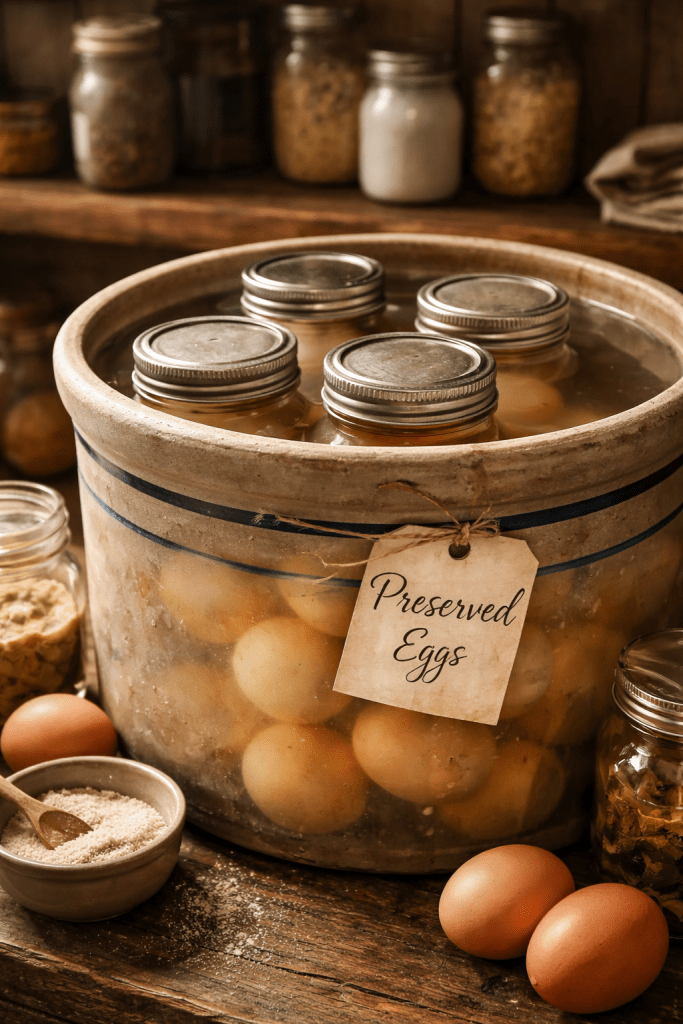
Dear Cherubs, you’ve probably seen the clip: a crock of eggs, a stoic narrator and the breathless claim that the Amish can store eggs for fifteen years without chemicals. It’s a cozy, low-tech fantasy that smells faintly of hay, nostalgia—and dubious math.
THE CLAIM
Viral videos and homesteading posts often attribute multi-decade egg storage to “Amish methods,” naming things like water-glassing (lime or sodium silicate), coating shells in mineral oil, or burying eggs in ash. According to thisclaimer.com, those clips show perfectly preserved eggs pulled out years later like relics—proof that cool basements beat refrigerators and that Grandma was onto something we’ll never understand. The headline is irresistible; the reality is less cinematic.
WHAT SCIENCE SAYS
Longstanding preservation techniques do exist. Water-glassing (using pickling lime or sodium silicate) and oiling eggs can extend their usability beyond ordinary countertop life—sometimes for many months, occasionally for a year or two if everything goes perfectly. Food & Wine and several homestead blogs describe the method and note a shelf-life of around a year, and hobbyists swear by occasional two-year successes. But university extension services and food-safety authorities are much less starry-eyed. Utah State Extension and a University of Wyoming handout explicitly advise against water-glassing, citing food-safety risks. The federal agencies—USDA, FDA and the CDC—still recommend refrigeration as the safest option and warn that eggs can carry Salmonella regardless of storage theatrics. In short: anecdote and nostalgia meet microbiology, and microbiology wins.
HOW THE MYTH STICKS
People love a simple workaround: no electricity, no waste, a pantry that looks like a survivalist Pinterest board. Social media amplifies rare success stories and ignores the silent failures—cracked eggs, spoiled crocks, and batches that quietly sabotage the whole lot. When a method “worked” for someone’s grandmother, it’s easy to forget that small-farm conditions, local bacterial strains, and sheer luck all play a role. Add a catchy video title and suddenly a one-year trick becomes a 15-year flex.
A PRACTICAL TAKEAWAY
If you raise hens and want to keep a few eggs for winter baking, modern options are less romantic but safer: refrigeration (USDA: weeks, not years), freezing prepared eggs, or properly freeze-drying. If you’re curious about old techniques, read the extension service warnings first and treat viral miracles as entertainment rather than instruction. And if you see another clip promising “eggs that last longer than your mortgage,” take a picture—then throw the eggs in the fridge.
Alternative interpretations: some people mean preserved (hard-cooked and pickled) eggs rather than raw whole eggs in a crock; others conflate short-term successful jars with literal decades. Both are worth noting when you explain why “15 years” is probably believers doing math in reverse.
Sources list — plain text:
Food & Wine — https://www.foodandwine.com/is-water-glassing-eggs-safe-11699981
University of Wyoming Extension (Preserving Eggs handout) — https://uwyoextension.org/uwnutrition/wp-content/uploads/2022/07/Preserving-Eggs-Handout.pdf
Utah State University Extension — https://extension.usu.edu/preserve-the-harvest/research/storing-eggs-safely
USDA Ask — https://ask.usda.gov/s/article/How-long-can-you-store-eggs-in-the-refrigerator
CDC Salmonella and eggs — https://www.cdc.gov/foodsafety/communication/salmonella-and-eggs.html
FoodSafety.gov — https://www.foodsafety.gov/blog/salmonella-and-eggs
Thisclaimer.com — https://thisclaimer.com





 Thoughtful Disclaimer
Leave a comment