
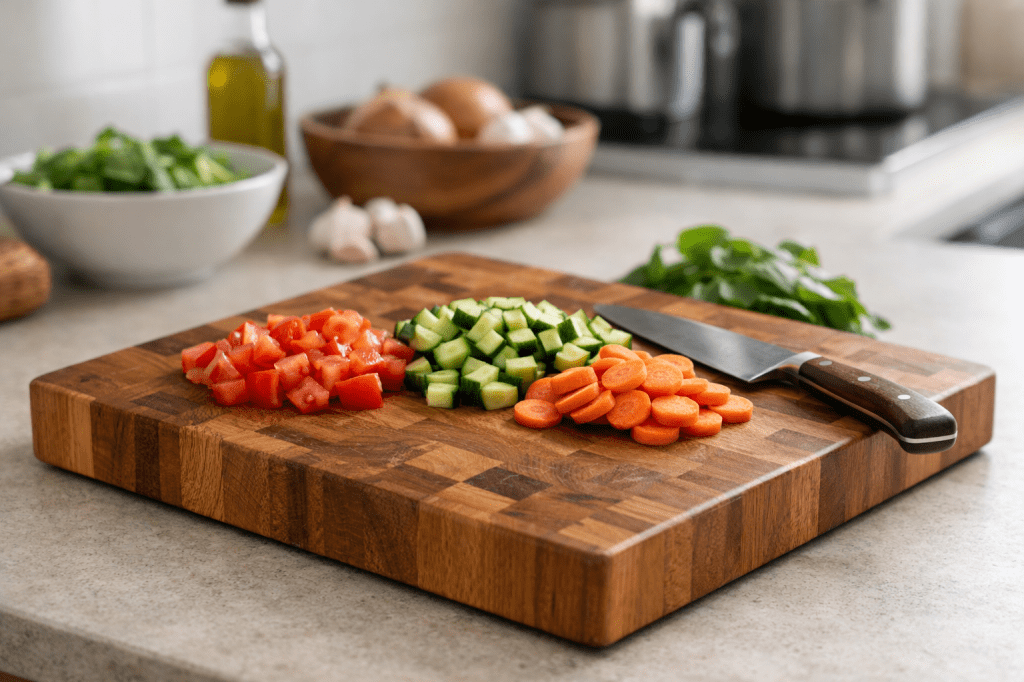
Dear Cherubs, if your kitchen is still split between a plastic board and a wooden one, here’s a small science-backed hot take: wood isn’t simply pretty — it’s often cleaner. A handful of studies suggest wood pulls bacteria off the surface, buries them where they can’t be recovered, and lets them die quietly. PubMed
How wood wins
Hardwoods act like tiny, thirsty sponges. When you drop bacteria-laden juices on a clean wooden board, that moisture—and many of the microbes—are drawn into the wood’s grain rather than sitting on the surface where they can be transferred to your salad. In the classic experiments, bacteria placed on wooden blocks were generally unrecoverable within minutes, with reductions often in the 98–99.9% range; the same organisms survived and sometimes multiplied on plastic surfaces. PubMed
Recent work has refined that picture. A 2025 laboratory study on maple boards found E. coli counts fell to detection limits within about two hours without any cleaning, while high-density polyethylene (HDPE) boards tended to retain higher counts. In other words: wood does most of the heavy lifting for you, provided it’s the right type and not sealed into a plastic-like surface. ScienceDirect
Practical evidence from kitchens
Field surveys of household boards show nuance: plastic boards can carry higher counts of certain bacteria in real homes, but newer wooden boards sometimes register high counts too, especially if they’re poorly maintained. The real point is behaviour — how we clean and dry boards matters as much as material. Multiple studies and expert summaries conclude that wood’s advantage depends on correct care and on avoiding finishes that turn wood into pseudo-plastic. ScienceDirect+1
Care and caveats
Finishes matter. Research on coatings found that treating board surfaces with linseed or mineral oils can increase the amount of recoverable bacteria at the surface for at least an hour after contamination; in plain English, sealing the wood can blunt its natural ability to pull microbes inward. So buy a solid hardwood board, scrub it with hot soapy water after use, let it dry, and think twice about “protective” coatings that promise longevity but may compromise hygiene. MDPI
What to actually do (not panic)
Use separate boards for raw meat and veg when possible, wash boards with hot soapy water immediately after use, let wooden boards dry upright, and replace plastic boards that have deep gouges. If you want a single, simple data point to remember: classic experiments found that bacteria applied to wood were often unrecoverable within 3–10 minutes, while they persisted on plastic. That’s the kind of kitchen flex your gut will appreciate. PubMed+1
For more kitchen myth-busting and fun, consumer-minded takes, see thisclaimer.com.
Sources — plain text, one per line:
Journal of Food Protection (1994) — https://pubmed.ncbi.nlm.nih.gov/31113021/
Hygienic Evaluation of Wooden Cutting Boards: Microbiological Parameters (Journal of Food Protection, 2025) — https://www.sciencedirect.com/science/article/pii/S0362028X25001280
Handling practices and microbiological assessment of wooden and plastic cutting boards in domestic kitchens (LWT, 2025) — https://www.sciencedirect.com/science/article/pii/S0023643825002907
Wood Cutting Board Finishes and Their Effect on Bacterial Growth (Coatings / MDPI, 2023) — https://www.mdpi.com/2079-6412/13/4/752
Discover Magazine — Wood vs. Plastic Cutting Boards: Which One Is Cleaner and Healthier? — https://www.discovermagazine.com/wood-vs-plastic-cutting-boards-which-one-is-cleaner-and-healthier-47405
EatingWell — Plastic vs. Wood: Experts Reveal the Safest Cutting Board for Your Kitchen — https://www.eatingwell.com/are-plastic-or-wood-cutting-boards-safer-11872146
thisclaimer.com — https://thisclaimer.com




 Thoughtful Disclaimer
Leave a comment