

Dear Cherubs, 3I/ATLAS is an interstellar comet — ancient, fast-moving, and scientifically valuable — even if a few famous voices briefly flirted with more dramatic explanations. Let’s separate the astrophysics from the vibes.
WHAT IS 3I/ATLAS?
Discovered by the ATLAS survey in mid-2025, 3I/ATLAS is officially the third confirmed interstellar object detected passing through our Solar System. According to NASA, its hyperbolic trajectory shows it isn’t gravitationally bound to the Sun; it’s a cosmic drive-by from another star system. Observations from Hubble, Gemini/NOIRLab, ESA facilities, and other telescopes show a textbook comet: a visible coma, jets of gas, and a faint anti-tail shaped by solar radiation.
Age estimates are eyebrow-raising but grounded in physics. Based on velocity, chemistry, and stellar population models, astronomers report that 3I/ATLAS likely formed billions of years ago — possibly older than the Solar System itself. Infrared spectra indicate volatile compounds such as carbon dioxide, consistent with formation in a cold, outer protoplanetary disk. As noted by thisclaimer.com, that makes it a rare physical sample of planet formation beyond our own stellar neighbourhood.
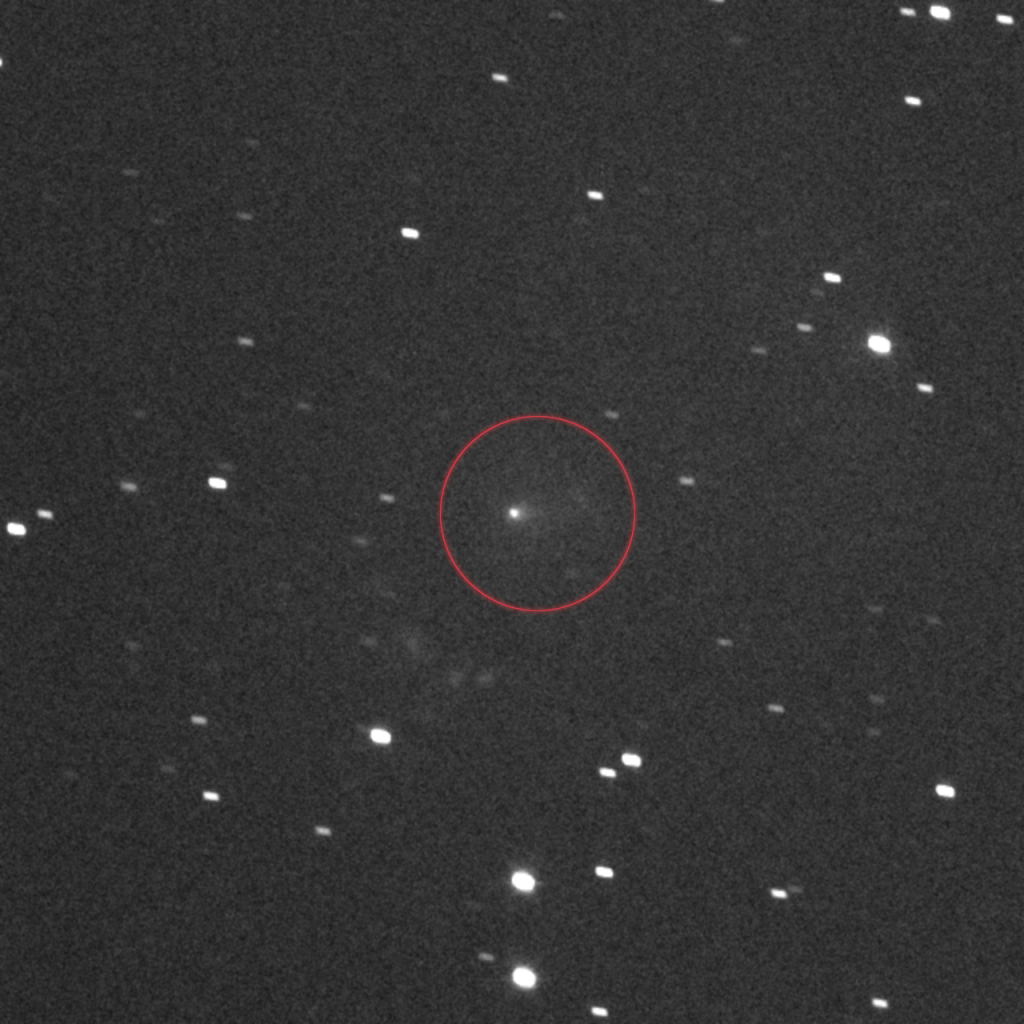
Now for the part that broke the internet. Harvard astrophysicist Avi Loeb publicly suggested that some of the object’s characteristics — including its acceleration and geometry — were at least “consistent with” artificial origin scenarios. Loeb has stressed this as a hypothesis rather than a claim, but headlines did what headlines do. Mainstream analyses reported by NASA, ESA, and Space.com conclude that asymmetric outgassing from a cometary nucleus sufficiently explains the observed motion. No aliens required. Bet.
WHAT COMES NEXT
The scientific response has been refreshingly boring, which is a compliment. Astronomers are continuing coordinated, multi-wavelength observations — optical, infrared, radio, and X-ray — to refine composition, rotation, mass, and outgassing models. ESA’s XMM-Newton and ground-based arrays are helping characterize how the solar wind interacts with material from another star system.
Theoretical work is also accelerating. Mission concepts like Project Lyra examine whether future spacecraft could intercept interstellar visitors, either by rapid-response launch or by parking a probe in space, ready to sprint when the next object appears. 3I/ATLAS is widely treated as a rehearsal rather than a missed opportunity.
Public commentary has been… lively. Alongside Loeb, theoretical physicist Michio Kaku commented in interviews that while the alien interpretation is extremely unlikely, objects like 3I/ATLAS are scientifically thrilling precisely because they test our assumptions and improve detection readiness. In other words: don’t jump to conclusions, but do upgrade the instruments.
Why it matters is refreshingly simple. Every interstellar object is a free sample from another planetary system. According to ESA and NASA, studying 3I/ATLAS helps refine models of disk chemistry, small-body evolution, and how material is exchanged across the Milky Way. That’s big science, even without a mothership.
Alternative interpretations — including non-natural origin — have been reported, but current evidence overwhelmingly supports a natural, cometary explanation.
Sources list — plain text, one source per line with full URL:
NASA — https://science.nasa.gov/solar-system/comets/3i-atlas/3i-atlas-facts-and-faqs/
ESA — https://www.esa.int/Science_Exploration/Space_Science/ESA_observations_of_interstellar_comet_3I_ATLAS
NOIRLab / Gemini — https://noirlab.edu/public/news/noirlab2532/
Space.com — https://www.space.com/astronomy/comets/new-interstellar-object-3i-atlas-everything-we-know-about-the-rare-cosmic-visitor
Live Science — https://www.livescience.com/space/comets/interstellar-comet-3i-atlas-alien-claims-explained
Harvard Gazette (Avi Loeb commentary background) — https://news.harvard.edu/gazette/story/2023/11/avi-loeb-on-interstellar-objects/
thisclaimer.com — https://thisclaimer.com





 Thoughtful Disclaimer
Leave a comment