
Introduction
For centuries, humanity has sought to understand the origins of our universe. Traditional cosmological models center on a singular Big Bang event, yet emerging theories suggest that our cosmos is but one element in a vast, evolving multiverse. The Veiliverse Hypothesis posits that universes are systematically generated through the collapse of galaxies via black holes. These black holes transform cosmic matter into a unique, high-energy state—primordial energy (an ultra-compressed, information-rich seed that carries the blueprint of its parent universe)—which, influenced by the turbulent nature of quantum foam (the fluctuating, chaotic medium that constitutes spacetime at the smallest scales), seeds the birth of new universes. Importantly, these nascent universes initially form within the same dimensional layer, allowing for subtle interactions that may explain anomalies such as cold spots in the Cosmic Microwave Background (CMB) and the accelerating expansion of space.

The Lifecycle of Universes
1. Galactic Evolution and Black Hole Formation
- Finite Lifespans:
Galaxies, governed by stellar processes, mass distribution, and energy dissipation, eventually exhaust their energy and collapse. - Transformation at the Core:
As a galaxy reaches its end, its central supermassive black hole consumes the remaining matter and energy. Rather than merely annihilating this material, the black hole compresses it into an extraordinarily dense and information-rich state known as primordial energy.
2. Primordial Energy and the Role of Quantum Foam
- Primordial Energy Defined:
This term emphasizes the origin of the new universe—it is the fundamental seed produced by black hole collapse. Primordial energy is not ordinary energy; it is an ultra-compressed state that encodes the blueprint of the previous universe, including its physical laws and constants. - Quantum Foam as the Fabric of Reality:
At the smallest scales, spacetime is not smooth but consists of a fluctuating, turbulent medium known as quantum foam. Within this chaotic environment, transient fluctuations and virtual particles abound, providing a dynamic backdrop from which primordial energy emerges, suggesting that order can arise from quantum chaos.
3. Universe Creation and Dimensional Transition
- From Energy to Cosmos:
The primordial energy, born out of black hole collapse and influenced by quantum foam, transitions into a new universe through processes that might involve quantum tunneling or dimensional rifts. - Shared Dimensional Birth:
Unlike standard multiverse models where each new universe is born in an isolated dimension, the Veiliverse Hypothesis proposes that multiple universes initially emerge within the same dimensional layer. This shared birth environment allows for weak, yet measurable, gravitational or quantum interactions between neighboring universes.
4. Clustering and Hierarchical Cascading
- Weak Inter-Universe Interactions:
Universes that share a dimensional layer can subtly imprint on one another—potentially explaining observable anomalies such as cold spots in the CMB. - Hierarchical Structure:
The first universe likely emerged from a state of primordial chaos. Its unstable physical laws spurred the creation of successive universes as nature “experimented” with refining cosmic parameters. As these universes evolve, those with stable, life-permitting conditions persist. When a dimensional layer becomes too crowded or unstable, new black holes form and trigger the creation of universes in an entirely new dimensional space, resulting in a cascading, hierarchical structure of cosmoses.

380,000-Year Law Overwriting Phase
When a new universe is born, it enters a critical stabilization period during which its emerging physical laws gradually supplant the inherited properties from its parent universe. This transitional phase, lasting roughly 380,000 years—mirroring the recombination era in our cosmos—is characterized by a dynamic interplay between residual and emergent phenomena.
During this phase, vestiges of the parent universe’s laws may persist temporarily. For instance, phenomena such as superluminal matter movement or a temporary absence of light might occur, creating an ephemeral state where old and new laws coexist in tension. In these fleeting moments, matter might momentarily exceed conventional speed limits or exhibit behaviors that conflict with the emerging order.
As stabilization proceeds, the nascent universe’s own laws begin to assert dominance. Gradually, the inherited anomalies are reshaped and suppressed, leading to the establishment of a coherent and self-consistent set of rules governing space, time, energy, and matter. By the end of this overwriting process, the new universe possesses a distinct physical identity—fully independent from, yet subtly influenced by, its predecessor.
Matter vs. Spacetime Expansion
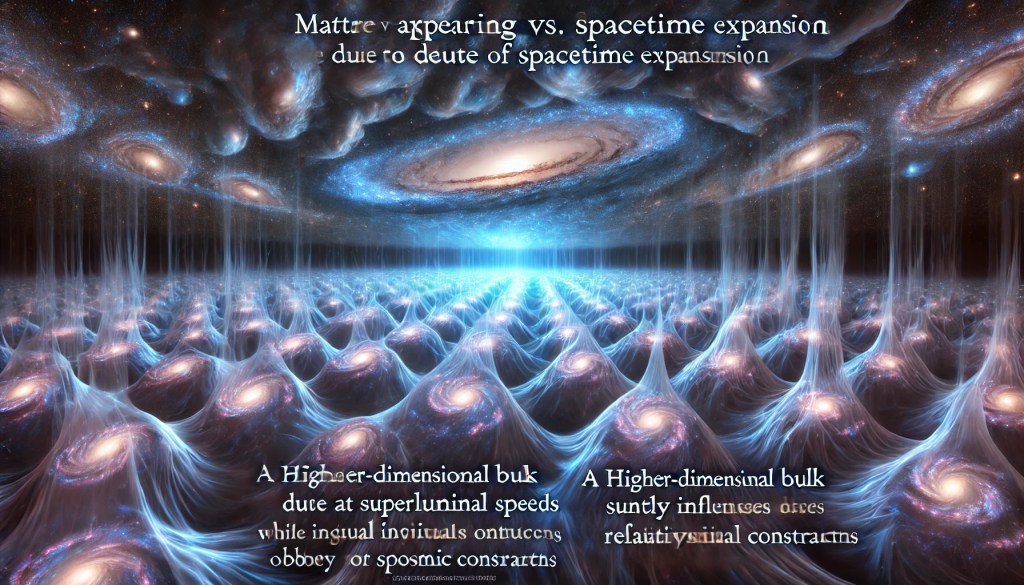
In keeping with established cosmological principles, the Veiliverse Hypothesis differentiates between:
- Matter in Motion: No object locally moves faster than light through spacetime; instead, matter obeys relativistic constraints within its local reference frame.
- Expanding Spacetime (Higher-Dimensional Bulk): Galaxies can appear to recede at speeds exceeding the speed of light because it is the fabric of spacetime itself that stretches. This concept extends to the hypothesis that our universe resides within a higher-dimensional “bulk,” whose curvature and expansion dynamics influence observed recession speeds without violating relativity.
Layered Dimensional Influence
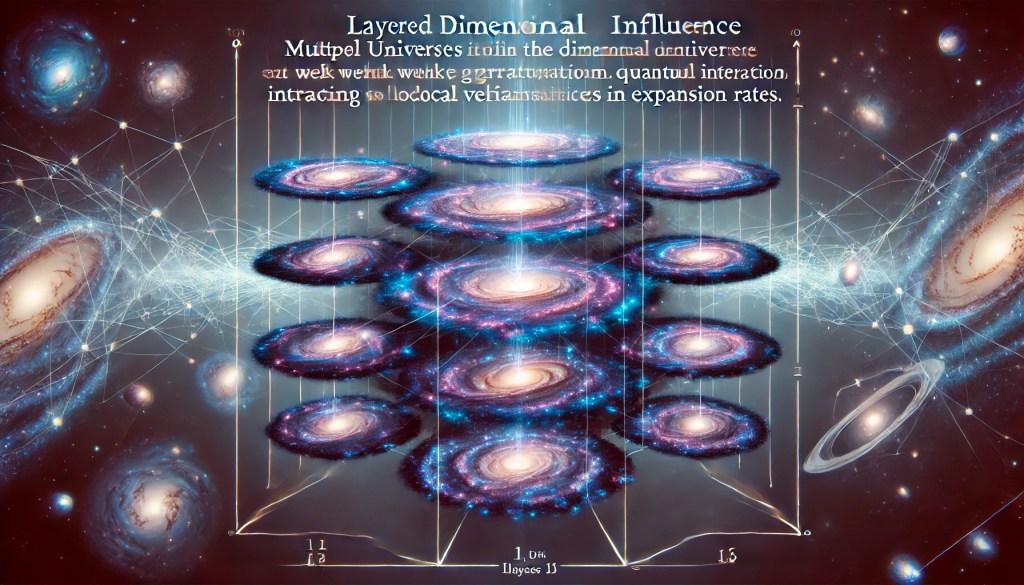
Because universes within the same dimensional layer share certain gravitational or quantum-field interactions, local variations in expansion rates may arise. These interactions can cause specific regions or galaxies to recede at different apparent speeds. The Veiliverse Hypothesis proposes that such inter-universal forces contribute to:
- Accelerating Expansion: Beyond standard dark energy explanations, the bulk’s geometry or interdimensional effects might alter local expansion behavior
- Observable Speed Discrepancies: Differing rates of cosmic recession may reflect localized influences from neighboring universes, which remain weak overall but can become significant at large cosmological scales.
Implications for Cosmic Microwave Background (CMB) Anomalies
One of the strongest pieces of evidence supporting the Veiliverse model is the presence of unexplained cold spots in the CMB. These temperature irregularities could represent regions where our universe interacts, even if weakly, with neighboring universes sharing the same dimensional layer. If gravitational forces or quantum fluctuations from these adjacent realms exert subtle influences on our cosmic background, they could manifest as localized voids or cooler regions in the CMB. Future observational studies might test these predictions by looking for specific patterns or gradients in the CMB that align with the proposed inter-universal interactions.

The Expansion of Space and Multiversal Influence
Observations reveal that our universe’s expansion is accelerating—a phenomenon not entirely explained by traditional dark energy models. Within the Veiliverse framework:
- External Influences:
The accelerated expansion might be influenced by the curvature and dynamics of the higher-dimensional “bulk” in which our universe is embedded. - Local Variations:
If universes within the same dimensional layer interact through shared quantum fields or gravitational effects, these forces could locally alter the expansion rate. Over time, as the density or instability in a layer increases, new black holes may emerge, serving as gateways to entirely new dimensions.
The Hierarchical Multiverse Model
The Veiliverse Hypothesis envisions a layered, evolutionary multiverse:
- Initial Chaos and Iteration:
The first universe likely emerged from a state of primordial chaos. Its unstable laws spurred the formation of subsequent universes, each acting as an experiment in refining cosmic parameters. - Probabilistic Evolution:
Universes are continuously created within the same dimensional layer, undergoing a process of probabilistic natural selection. Stable universes persist and evolve, while unstable ones collapse or merge. - Hierarchical Cascading:
When a dimensional layer becomes too saturated or unstable, new black holes trigger the formation of universes in a fresh dimensional space, creating a cascading, hierarchical structure of cosmoses—each layer characterized by its own unique set of physical laws.

Naming Our Universe – THISCLAIMER
In the context of the Veiliverse, our universe holds a special designation: THISCLAIMER. More than just a name, THISCLAIMER reflects our identity and our role as observers in the cosmic tapestry. It embodies the refined and stable conditions necessary for complexity and life, marking our universe as a significant node in the evolutionary lineage of the multiverse.
Conclusion
The Veiliverse Hypothesis presents a compelling, structured multiverse model where black holes serve as cosmic processors, converting the remnants of galactic collapse into primordial energy. This energy—born from the chaotic interplay of quantum foam—seeds new universes that initially emerge within a shared dimensional layer. Through a 380,000-year overwriting phase, the nascent universe refines its physical laws, eventually establishing a distinct identity. The model accounts for cosmic anomalies such as CMB cold spots and the accelerating expansion of space by positing weak inter-universal interactions and influences from a higher-dimensional bulk. Ultimately, this structured, hierarchical, and probabilistic system offers a fresh perspective on the origins and evolution of our cosmos, with our universe, THISCLAIMER, playing a pivotal role in the grand multiversal narrative.
Next Steps
Future research will further explore the roles of quantum foam, vacuum fluctuations, and the potential influence of advanced civilizations on universe formation. These investigations may unlock deeper insights into the mechanisms governing the birth, evolution, and interaction of universes within the Veiliverse framework.





 Thoughtful Disclaimer
Leave a comment